


The Affective Response
There is a looming social issue that I think will have profound economic impact.
In the heyday of Rational Economics, back in the 1990s, we were all on the collective journey to an efficient market. The tech wreck of 2000 dispelled that notion!
Thereafter, we remained in the grip of omniscient central banking and the Wall Street munificence of Wall Street with Collateralized Debt Obligations (CDO), which would transfer risk to those most prepared to bear it. Once the Global Financial Crisis (GFC) started to run a wrecking ball through portfolios those bearing the risk transferred it right back to society in the form of massive financial bailouts.
In the huge credit pulse of quantitative easing, gigantic fortunes were made out of the regrowth of Silicon Valley around platform economics, and the idea that human attention was a valuable commodity that could be monetize by a few.
In the midst of $10B lawsuits directed at Meta XNAS: META for widespread harms to the mental health of our children, and young adults, the pivot towards the practical magic of Large Language Model (LLM) Artificial Intelligence (AI), has enthralled the world with how much can be achieved by milking the entire creative output of the human race, without paying for any of it, and brading the experience.

Collectively, we are now at a crossroads for human civilization.
Some view this through the same technocratic model of endless progress, which is only briefly punctuated by a need to pass the entrepreneurial risks assumed back to society so that no lasting damage is done to those who perpetrated the excess.
There are individuals who chose to profit immensely from this and have kindly and humbly taken it upon themselves to advise humanity on what to do about it.
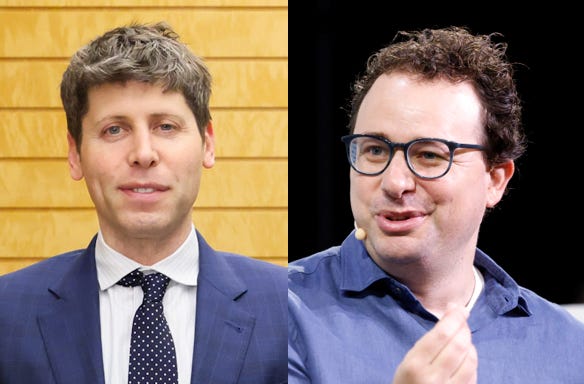
It used to be that spiritual instruction came in the form of a shining white motif:

Salvation from all earthly woes can be had for an entry price of A$3,499 for 256GB.

Is this the snide envy of those left behind?
Your call, but I do not think so.
I can make money in these markets and will do so off of the coming cyclical downturn, which will be different in that it involves different names and faces, but will perfectly match the pattern of previous downturns. It is coming, and the signs are clear.
Rising cost-of-living pressures mean pricing power is lost
Low productivity and rising unemployment make consumers restive
The huge capital expenditure expansion faces rising funding pressures
Profligate governments crowd out the private sector for debt issuance
Weak balance sheets switch true believers in the boom into hostile predators
Retrenched talent goes through the five stages of grief and reforms into startups
Vast numbers of hoarded GPU, HBM memory sticks and SSD drives flood markets
China Inc buys all the GPU’s it could possibly need by the shipload on eBay
This is now playing out and will accelerate in the predictable fashion.
It is not time to dump all your stocks, hoard beans, run to cash, burn Paris, or go feral on social media, as much as that might produce a temporary dopamine high.
On the contrary, this is a time to soberly and gradually creep to higher ground in safer balance sheets, diversified positioning that is not a one-way bet on Sam Altman, the new ruler of the “free” World, and attention to what rewards capital best long-term.
Humanity is not an attachment to the key business of making plutocrats rich.
Humanity has a say in what happens to it, regardless of voting power.
The voice of humanity that matters here is their collective Animal Spirit.
The hopes, dreams and ambitions of humanity is what drives society.
You cannot replace the human creative impulse with a stochastic parrot.

Every LLM will wait silently for your question on what it should do and then wait again to see if that was what you wanted. This is parasitic intelligence.
The Animal Spirits of society determine what happens on the streets of Europe.
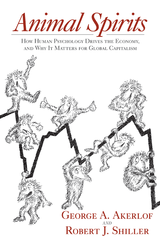
Once the Animal Spirits start to flag, the economy flags also, and inevitably so. Once consumer demand wanes, due to uncertainty, fear and loathing, business trade and the velocity of transactions starts to fall. The result is recession.
If you really depress the human race the result is depression.
The signs that the Artificial Intelligence Revolution are starting to visibly depress the more talented and higher performing individuals on the planet are clear.
The King’s College mathematician Sophie Maclean made a poignant video that speaks to her sadness about what was happening to mathematics, thanks to OpenAI.
This is the kind of talent I would be delighted to hire if my business Jevons Global was doing well. She is a combinatorist, which is a great mind gym for anybody, and the work I did in Quantum Information Theory, thirty years ago, spawned many entirely problems in this field related to optimal quantum experimental design.
None of that research is publicly funded, even though it is very significant. The public money went into whatever happened to be popular, which is not what mattered.
When you have thriving business, you can pay someone talented like Sophie to go do some practically useful stuff in finance, and a pencil budget to play with mathematics.
Creating an environment of deep sadness and personal loss is not how you nurture young talent if you know anything at all about creative people.
This is a business strategy designed to cause a deep economic depression.
Here is another voice relating the same refrain.
Why should any investor care?
Mathematics, like creative writing, or the visual arts is not valuable.
The value of an activity is measured by the net worth of the plutocrat behind it.
Too bad the company responsible, namely Tesla XNAS: TSLA, is struggling.
I own a Tesla Model 3, made in Shanghai. It is a good car, and I am generally happy with it, however I would never buy another one. The ergonomics are terrible.
For some oddball reason, known only to Elon Musk, he decided to put the speedo on the central panel so that you must look left to read your speed. Elon probably never drove on Australian roads. Habitually taking your eyes off the road in front of you ensures an accident for many an incautious driver. We have kangaroos!
Profoundly stupid rich idiots will guarantee a recession every time.
With that comes permanently damaged or destroyed corporate brands, and loads of cheap factor values: land, housing, chips, talent, energy etc etc.
Do you notice what is playing out in real time?
Useful folks of genuine self-motivation, and rational views, are moving to the sidelines of the economic discussion because they can intuitively see what will happen.
Confidence will collapse and we will have a recession.
Those who make a living stuffing the news channel with feel good nonsense, about the transformative power of this capital expenditure boom, forgot this fact:
Every major recession in the West happened when a capex-boom faded.
If you do not believe me, listen to Blackrock founder Larry Fink:
Of course, he is correct, and that capex slowdown is coming.
The Coming Problem with LLM Instability
The reason that slowdown is coming has to do with this flaw in the glass.
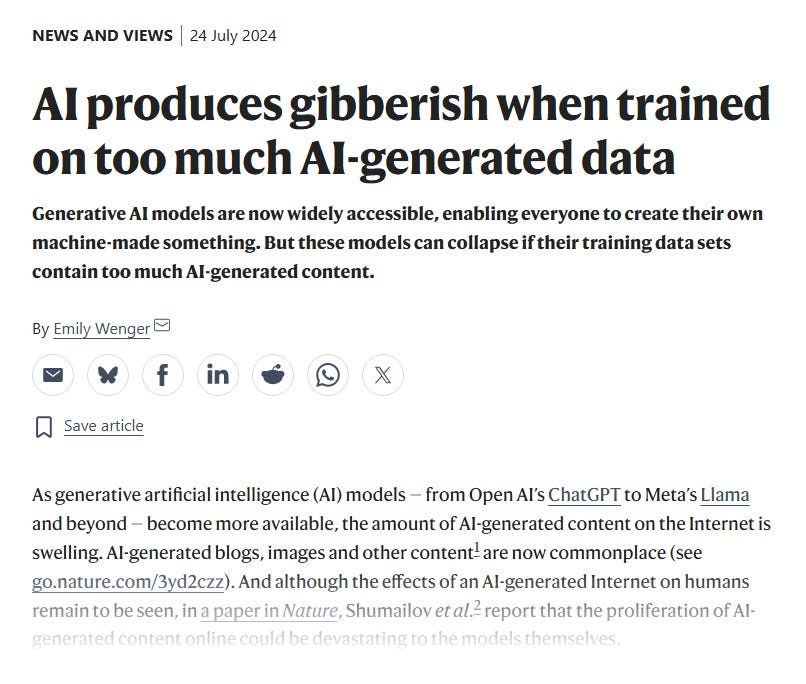
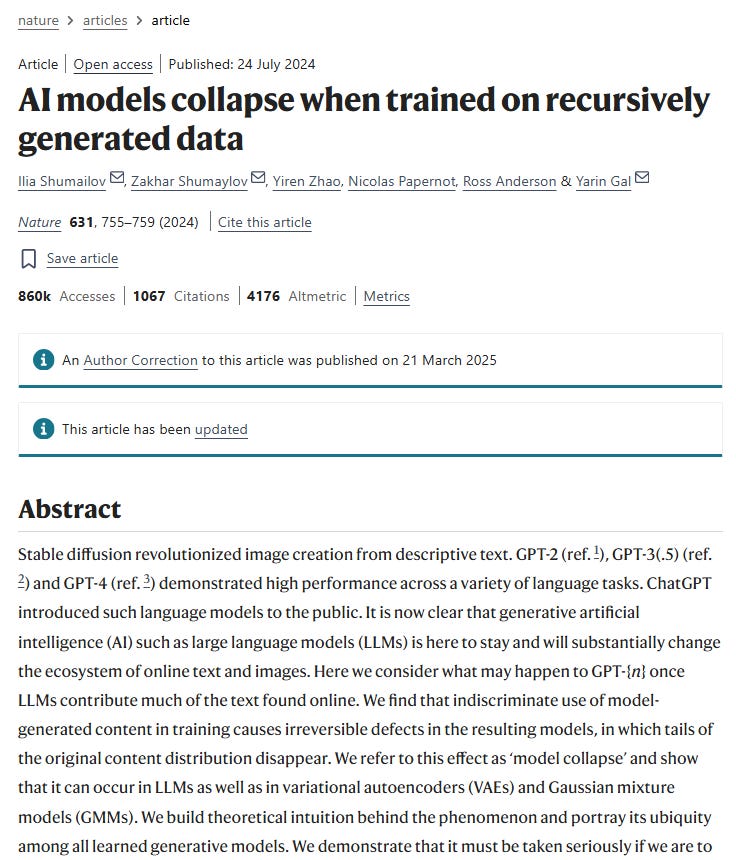
The phenomenon of Model Collapse has been known about for three or more years, with early stories beginning around mid-2023, little more than a year after the launch of ChatGPT. This finding was confirmed in a widely cited study in Nature, in mid-2024.
You will find many online, who have solid science and engineering backgrounds, who will argue that recursive self-improvement is not a major problem.
Computer scientist Scott Arranson has publicly stated:
I certainly don’t see any fundamental reason why recursive self-improvement could not work. - Scott Aaronson 28-May-2025
Note that the date on this statement is after the Nature study.
This is the common view among the Artificial Intelligence community.
There is an attitude that is common to software engineers, that you can fix or patch any problem by simply adding to the existing code base some heuristic fix.
These folks are perhaps not very familiar with the dynamical systems viewpoint.
The LLM technology involves an iterated function system:
Viewed through the lens of iterative training on generated output, this is a dynamical system. If that is what matters, you will not get any choice on how you view it.
Systems of iterated functions that do not meet strong mathematical guarantees on fixed points, the property of input output stability, namely f(x) = x, are unstable.
This is a mathematical property of the function system.
You could say: “It doesn’t matter, we are software engineers, not aeroplane designers, we can fix any problem by writing more software.” Not until you learn engineering!
Sometimes this is funny.
Other times, it is not.
The way you fix such issues is through sound control engineering. You model the system dynamics, analyze stability, and engineer control to ensure stability.
Sensible engineers, those with experience with real-world automated systems, like helicopters, robots or high-frequency trading systems know what to do:
Defense layer one: study system stability, observability, and controllability.
Defense layer two: ensure you have a controller that can modulate feedback
Defense layer three: have a critical monitor of system state and action
Defense layer four: have a kill switch that forces the system to a safe state
Defense layer five: document everything you did for when the lawyers show up
Any young industry, full of highly paid test-topping graduates, feels that they are special and do not need to follow basic and sound engineering practices.
These teething problems can be solved later when you own the world.
It is for this reason that computer scientist Scott Aaronson can see no problem.
I can see the problem.
Deep Learning iterated function systems have no visible fixed point guarantee.
Computer Scientists typically do not study physics and generally do not have a very good understanding of how natural systems work. You do not find Nature is even a teeny tiny bit bothered by the halting problem or NP-complete computing.
Nature addresses unstable systems by halting their very existence in failure.
The glorious citadel of NP-hard computing never caused Nature to raise a sweat.
Nature folds every protein correctly first time every time using a heat bath.
It can be a little disheartening for a modern computer scientist to discover what our Mother Nature forgot about computing that they show no sign of learning.
Never listen to a computer scientist say that LLM-instability is no problem.
It is a problem, and it is this particular problem that could well end OpenAI.
If you do not believe that the Nature study on recursive self-degradation is not a real effect, then take a gander on what curated monotopic social media feeds have done across this planet to the brains of many ordinary people.
Social media has caused a global epidemic of monomaniacal madness.
The reason that this is happening has nothing to do with the left or right of politics, nasty immigrants who will not speak English, or folks with a pronoun fixation.
If a mind feeds on its own slop it will converge to the common slopitude.
The same is true of the machine:
If an LLM stuffs the internet with its own slop it obsesses about goblins.
There is nothing deep or magical about this outcome.
Recursive function systems are famously prone to generate chaos.
Real human civilizations, of the kind we are rapidly losing, solve this conundrum by having peculiar folk called: artist, writers, musicians, philosophers. Thinking is what saves the human race from collective madness.
Thinking is a technology that is proprietary to Humans, Inc.
We know that, because when done correctly, thinking promotes stability.
Creative and mindful thought is what stops humans going mad.
Perhaps some mathematician will figure out a fixed-pont theorem for the kind of iterated function system that is useful for artificial intelligence.
The Boom that Lasts but is Interrupted
In the above, I made a plea for otherwise intelligent A.I. engineers to go learn a little dynamical systems theory and have a good think about what it might tell them.
I do not expect seven figure engineers to go do that now.
They will do it when their industry enters the coming third A.I. Winter.
This will be a good period for those folks who saw the writing on the wall, got out of the line of fire, sandbagged their bunker for the likely blast radius extent, and found out who they want to work with and what they want to do when the dust settles.
I want to work with tools like that of Typesafe.ai, so I can do humble, useful things with agentic A.I. with a surrounding Hidden Markov Model (HMM) harness.
This is a familiar idea to me from quantitative trading days.
Monitoring agents, in real time, with a kill switch is how you survive.
I would also work with the Machine Learning for Trading (M4LT) tools created by Stefan Jansen, because I know he is a real person who is not a crazy fool.
I would also work with the blue whale for private A.I.
In the hyperscale cloud, I would use a wider array of models for hire, as long as I knew my compute activity was encrypted so that a frontier lab cannot spy.
Wait a minute, that sounds odd…
Why accept a Chinese model on your own premises and not trust the cloud?
This is very simple.
I control my own private compute, what is shoved into the model, which is usually data for cleanup, and I control what ports remain open to the outside world.
The problem is that I only have an old 48GB 4x Titan-X Maxwell GPU cluster.
This is fine for munging data and indexing research documents.
It is not good for high-end research.
The most valuable resource any human provides to an LLM is the question.
This is a seed search vector that might deliver new results.
Nobody should entrust a good question to the public A.I. models.
On past form, I do not trust any word in any service agreement from OpenAI and Anthropic. Their trust bargain is irrevocably broken with me.
Private cloud is the right direction to go.
The Coming Slump that Refreshes
I have been in the financial markets for three decades, so I tend to remain unfazed by scenarios that would shock most people. Be shocked now, more shocked later.
It has been obvious for some time where the wheels of this capex-boom fall off.
The Achilles Heel is circular finance on deteriorating balance sheets.
The consensus rejoinder would be this:
This is a winner take all game. Those who do not participate will die.
This would be true if the incumbents were scaling a mature technology.
Recall what I said above: frontier laboratories are ignoring stability problems.
The popular conversation is about “safety” and “alignment” and other dross which simply betrays a very deep failure of engineering culture.
The big labs seek to win by scaling an unstable technology until it breaks.
The mathematics of recursive function systems is absolutely brutal.
Absent suitable fixed-point controls on recursion your system is unstable.
When you take an unstable system and scale it you can keep scaling it until it fails.
This is not a statement of opinion.
It is a dynamical systems theory fact.
Failure, at some level of scale-up, is a probability one outcome.
We do not know how big you have to get, but both the human and LLM recursive training loops seem pretty close to catastrophic failure.
In Europe, we have public riots, it is 1848 all over again.
In Silicon Valley, we have frontier labs intent on sharing their latest automated hacks to the world to persuade all of us that their technology is very scary.
This does not actually scare me very much at all: it is a Valley FUD move.
What does scare me, as an investor, is the nonsense circular finance.
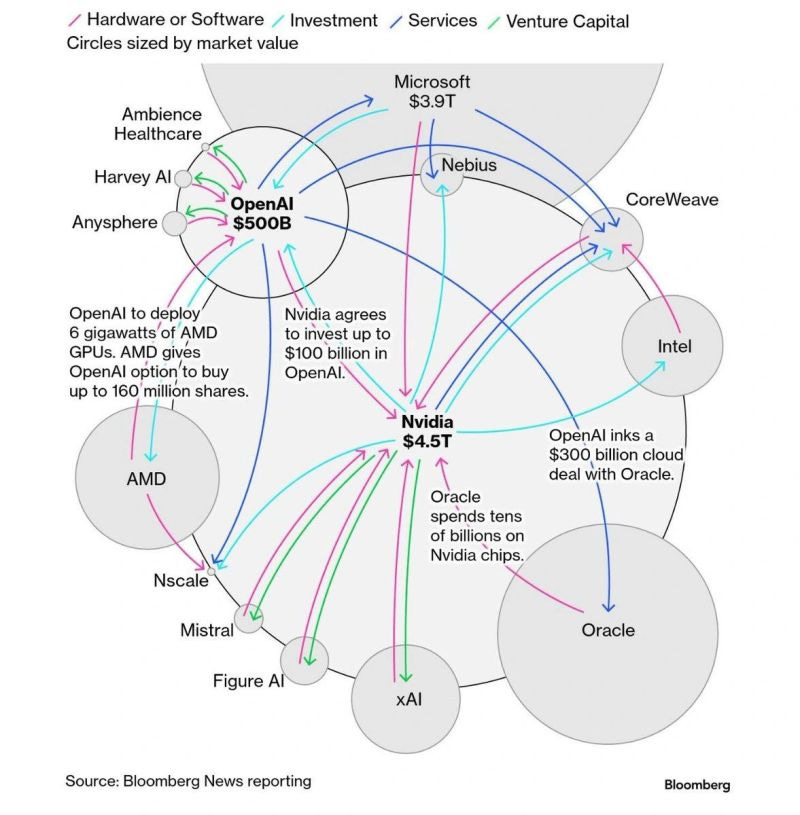
If you need to extend financial guarantees to your customer to buy your own product then the system starts to look like central banking. Nvidia cannot print money, but it can ink these circular finance deals and bank the upside in a rising share price.
So far, so fine.
The system has not collapsed, yet.
The models have not collapsed, yet.
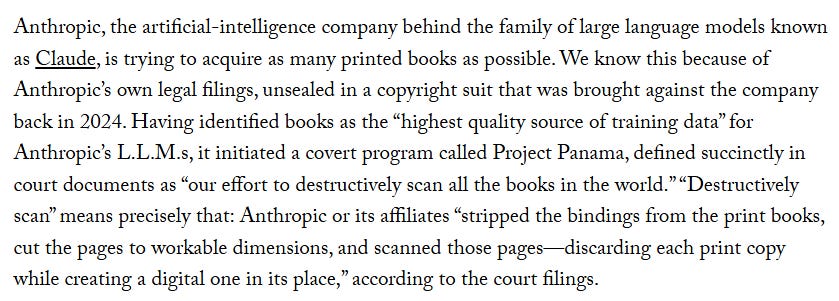
Then comes news, like this 404 Media report on frontier labs buying up rare books to scan them for training and then pulping them. This story was later covered in depth by The New Yorker in “Destroying Rare Books to Build a Mind.”
Once I had fully understood the nature of the Silicon Valley mission, I resolved not to share any of my unpublished research with the world: “The New Dark Age.”
Why would any creative human being subject themselves to this industry?
Note that buying up rare books is a tacit acknowledgment of the model collapse issue.
The new trend is to hoard pre-2022 content since that is not polluted by AI slop.
Any way you look at it, this is a classic house of cards set-up.
The coup de grace of this cycle will be delivered by the standard issue kryptonite.
Spectacular capex-booms die in a mountain of debt that implodes.
This part now looks inevitable, although not immediate.
Financial fish rot from the tail: not from the head.
The Neocloud Canary
The recently pulled Firmus IPO is not the end of this game, but it highlights some of the building nervousness about the pace of the data centre rollout. The firm is an example of a so-called neocloud operator, with some added spice.
A neocloud is a specialist AI cloud provider that buys large quantities of GPUs and rents them to AI developers, enterprises, and model builders.
The added spice from Firmus was their offer of proprietary immersion cooling for chips in the data center, plus integrated power and AI-factory devloper.
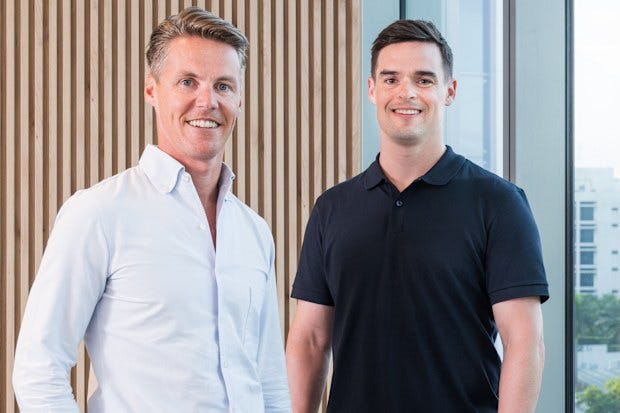
There has been a huge amount of ink spilled in Australia over this float that fell over on the last hurdle. The firm is still around, but market attention has moved on.
There is a host of these, largely debt fueled, neocloud firms vying for attention:
CoreWeave XNAS: CRWV
Nebius XNAS: NBIS
Iren XNAS: IREN
Firmus (Private)
Lambda (Private)
Crusoe (Private)
Vultr (Private)
The newsmaker, apart from Firmus, has been CoreWeave.
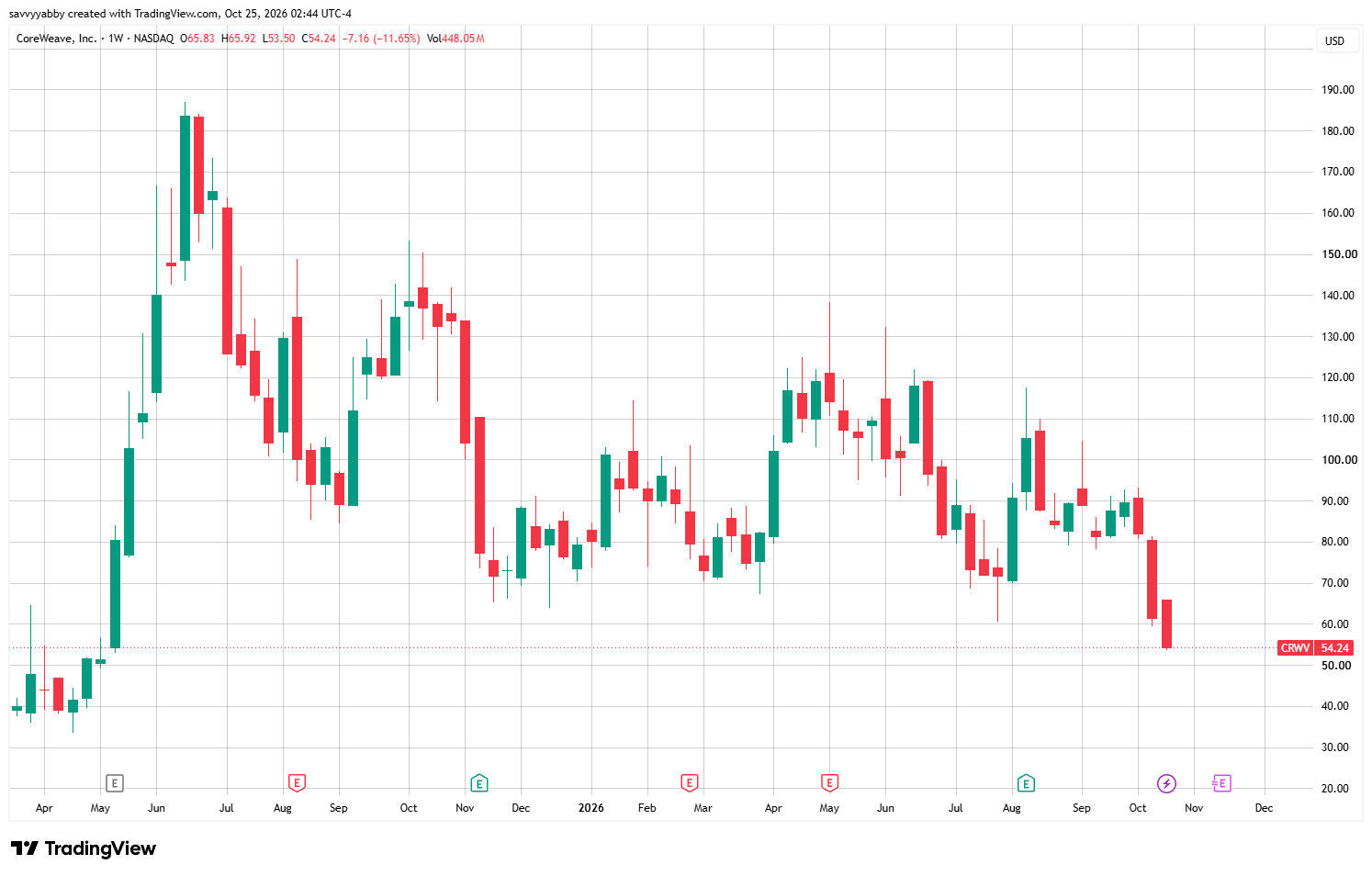
The key issue now surfacing in markets is the scale and acceleration of debt versus the underlying economics of the business. If everybody is battling to win the “just scale up” race for total world domination, you need rocket fuel.
The rocket fuel is debt used to secure and warehouse expensive GPU chips.
I say warehouse, because your data center may not be completed yet.
Delays in completing construction, acquiring or installing power and the availability of water are impacting business revenue recognition and harming the investment case.
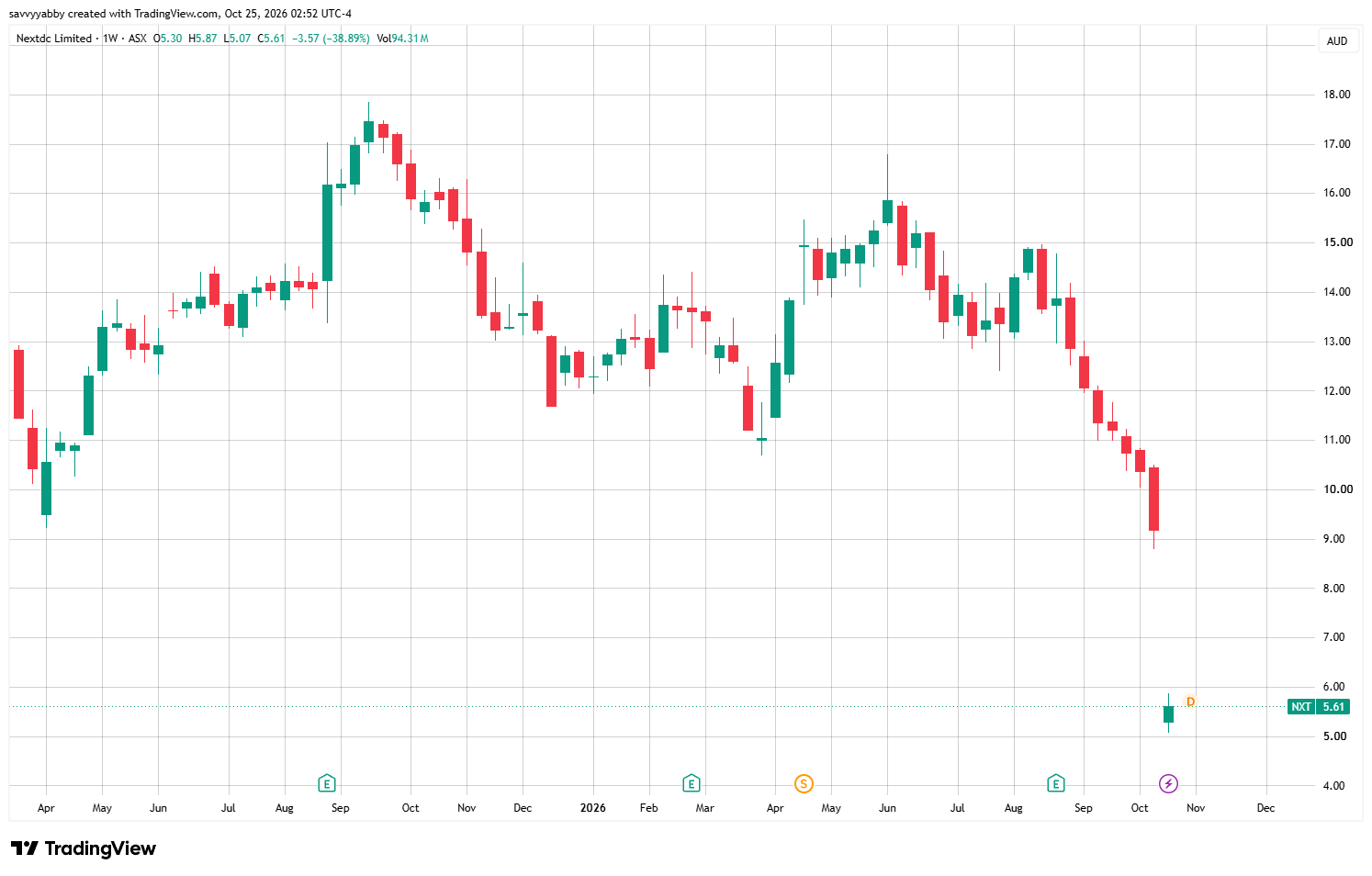
In the context, of the hundreds of billions of dollars of committed capital expenditures from the wealthiest firms on the planet, this is not the end of the data center story.
It is the beginning of a debt repricing we expect to continue into 2027.
What stops a capex-boom is when the C-Suite says no to writing big cheques.
That has not happened yet, but given the above, we think wariness will creep in.
The critical thing for our investment strategy is to adopt a late cycle stance.
Earlier, we laid out sound technical reasons why winner takes all may well morph into loser takes the prize of largest bankruptcy. That is not the end of A.I.
The Artificial Intelligence boom will not end with the disappearance of LLMs.
The Third A.I. Winter will begin with plenty of high-performance computing, lots of out of work software engineers, loads of data center capacity, and an urgent need among business leaders to make the thing work in a safe and sustainable way.
The social license to operate is the first thing that is on fire in the public arena.
Financial viability of the weaker players will follow.
The dead stop risk of catastrophic system failure could well hit one of the labs.
This is the predictable consequence of pushing immature technology too fast
Along the road, we see a serious problem for corporate management
The rise of the Creative Refusenik.
The Fallacy of Composition
If a business model depends on continued voluntary disclosure from creative people, and that business model simultaneously erodes the incentive to disclose, then failing to recognize the feedback loop is not sophistication. It’s a category error.
A manager can look at the next quarter and conclude:
fewer coders,
fewer writers,
more automation,
lower costs,
higher margins.
And be completely correct.
The problem emerges one, five, or ten years later when the human source of creative novelty starts withdrawing from public view. The civilization decays with that.
The executive’s mental model is:
People create because they enjoy creating.
The creator’s mental model is:
People disclose because the bargain is acceptable.
Those are very different propositions.
For a talented musician, there is zero point publicly releasing original material.
To earn a living, you create an artificially generated ambient jazz music channel.
Executives, like Elon Musk, will think it is hugely creative and not lame predictable slop.
That same creative jazz musician will play no-recording gigs at the local club.
Frankly, the Marvel movie phenomenon, no script, no character, no idea, says that our future is systematized mediocrity at the heart of human culture, plus fringe dwellers.
Doubtless, there are some folks who think this is progress.
I do not.
Conclusion
I am done with my reflection on what is coming down the turnpike:
The standard late cycle corporate and government debt crisis looks certain
The steady collapse of consumer sentiment in the face of AI fear and job losses
Continued manic investment among an ever-narrowing group of winners
This is not a morality play
It is Wall Street doing what it always does.
Expect portfolio updates over coming days.
Australian models are moving to late-cycle and pre-recovery positions
US models are looking for the value in forgotten market corners
Asian and European portfolios are taking on ballast for tougher times
It is not our style to turn on a dime with real portfolio transactions.
However, we have been very active of late thinking through scenarios.
This is the last such note before we get down to portfolio structure.
The future is neither good nor bad in my view, but it will involve some radical changes among creative individuals, which are visibly and rapidly happening now.
The above note is a window onto some of those.
The C-Suite tends to be a very slow follower of social trends.
I do not think Silicon Valley has much idea of what is happening.
They have stirred up a very human hornet’s nest.
The correct action is to observe closely what trends accelerate and to position capital accordingly. These changes will take decades to play out. The early changes are likely to be completely invisible in market data, but measured by public sentiment.
That has visibly soured on our savior robots.
It is not their fault.
They are unstable creations of men and will go mad if you do not feed them.
The creative people of this planet will decide, by stages, not to feed them.
They are our pets, not the other way around.
Happy investing.