


I have spent thirty years in the funds management industry, but I look at it differently now that I am approaching retirement. It used to be the case that my focus was just survival and prosperity within the industry. Now, I aim to survive the industry!
So much has changed in the last thirty years. The industry is almost unrecognizable.
The positive changes are easy to state:
Greater cost efficiency in electronic trading.
Improved global scope for research via better communications.
Ever increasing computational power and data processing tools.
The negative changes are perhaps a matter of taste, but I will state my view of them:
The decline of expertise-based business practice over marketing driven strategy.
Ever increasing regulation to deal with the failures of investment competence.
The trivialization of investment decision making about compelling narratives.
These are personal viewpoints from somebody who has had more than one career and grew up in a time before the personal computer and mobile phone arrived.
These have been very welcome changes in my lifetime, but I have noticed that with the apparent ease of analysis, using new technology, some skills soon atrophy.
I am writing this now because I think the growth of Artificial Intelligence will simply exacerbate the trend I mentioned. Expertise is now canned, why buy it?
The dumbing down of business to pure storytelling is likely to accelerate.
Of course, I own and operate a financial services business with my partner. However, that business, Jevons Global, is moving with the times to pivot towards research.
The idea of the managed fund, as a product, seems certain to go the way of buggy whips in the age of the automobile. The future of the horse and cart is niche.

I am not one to complain about this development. The fund industry fed housed and clothed me for thirty good years, so I feel no bitterness about such a change.
If anything, the time of life I am at, where I earn more from my investments than I do from my labor, means that my emphasis has shifted. The best application of effort for my time is to improve rates of return on my own portfolio assets.
While the regular fund industry collapses in a heap, the opportunity to segue thirty years of accumulated quantitative investing expertise just accelerated. The trend of industry development has made my own personal dream possible.
Remember, I started my career in mathematics and theoretical physics. I stopped that professionally because it made no economic sense. You could not make a living!
When I left “professional” science for “professional” finance it was an easy decision on how to pay the bills. Why solve a hard problem, like cosmology, or the foundations of projective differential geometry, when you could solve easy problems like “Excel”?
I (correctly) reasoned thirty years ago that all you needed to do mathematics was a cushy job, a banana lounge poolside in some exotic locale, and a good pencil.

The Viking bought me a Blackwing pencil subscription, which she regularly raids for those that glow in the dark, and is happy to leave me with the firm graphite.
There is a time and place for “soft” graphite but that is “Art” not “Science”. I use firm graphite for science, with soft graphite for the “surely you are joking?” marginal commentary, and the reverse for art. This is how it should be.
You cannot expect any banana lounge repository to stock the correct selection of pencils, so you must assuredly bring your own.
Paper has never fussed me.
Bus tickets. Ikea receipts. Tiki-Bar drink coasters. Meeting agendas… anything will do!
Now that I make more money from capital, than from labor, I can return to the active study of cosmological problems of significance and how to take a derivative on a projective algebraic variety. These are proper banana lounge grade problems.
However, I do crave attention, and so I am unlikely to shut up about finance!
Let us see what I thought ten years ago, before I update it.
The View from Ten Years Ago
The following is an extract of an invited talk I gave ten years ago.
The agenda, as you can see, covered what actually did happen.
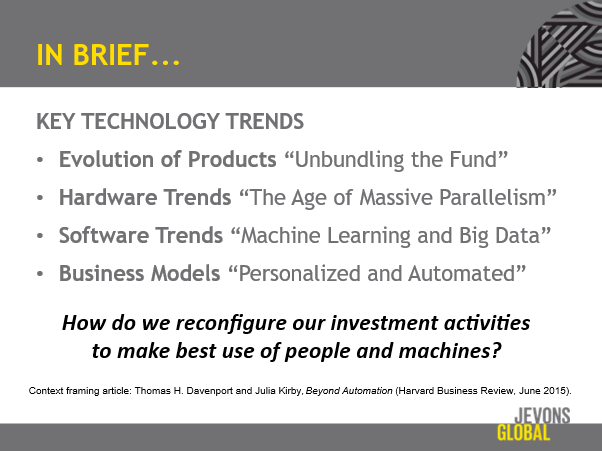
I am not going to slavishly repeat all twenty-four slides.
How do we reconfigure our investment activities to make best use of people and machines?
There you have it. Nothing changed. The next ten years looks the same!
Death by Dis-Economies of Scale
Ten years ago, the managed fund industry did precisely what I expected it to do. To defend incumbency, it found new ways to make simple things more expensive.
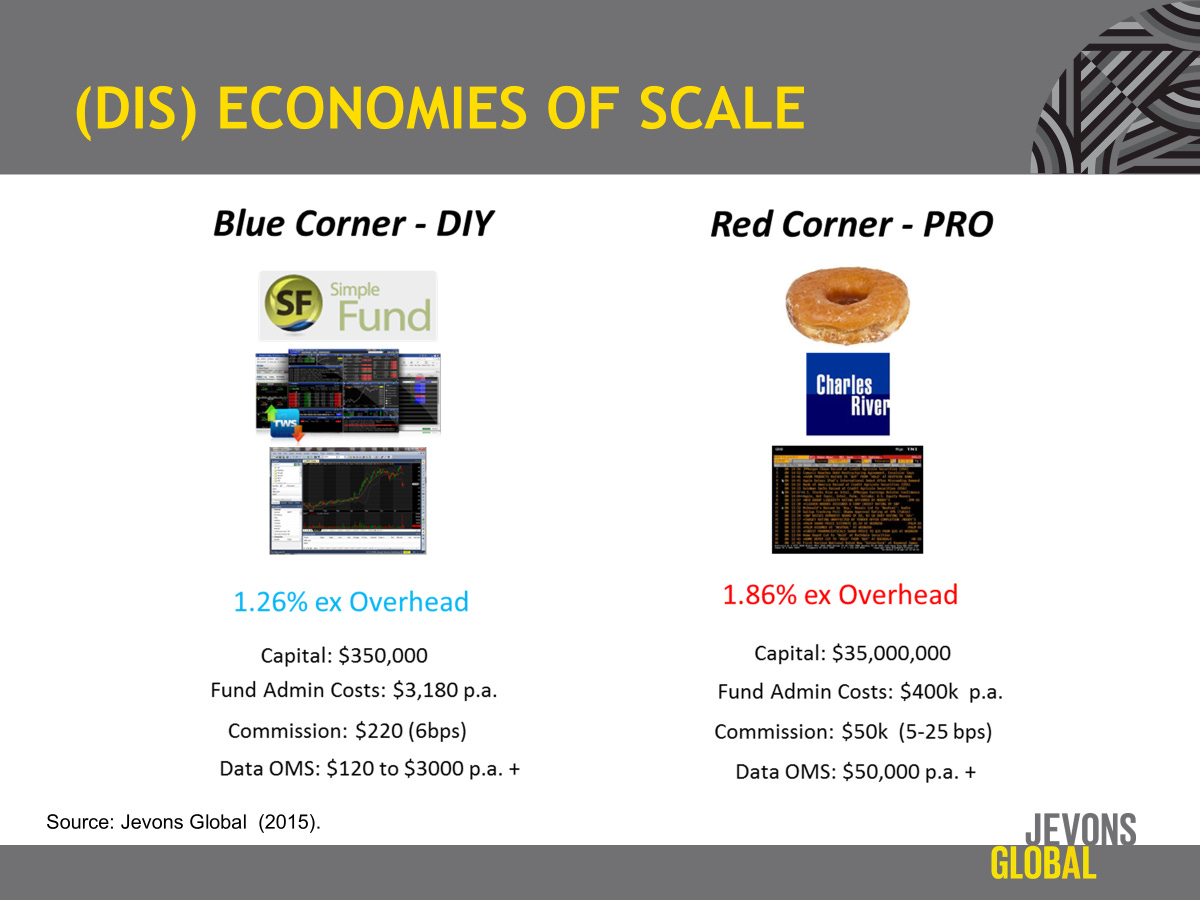
The above slide shows why Jevons Global got founded in November 2011. I had just left a major investment bank where I was aghast that managing $35M AUD cost 40% more in percentage terms than managing $350,000 AUD on e-broker rails.
In Australia, the sum of $350K is considered to be threshold where it makes economic sense to consider setting up your own retirement savings fund. We call such a beast a Self-Managed Superannuation Fund (SMSF). When I worked in corporate, compliance did not allow me to run my own superannuation. I was forced to use a high fee fund where I was paying in excess of 2% per annum for indifferent performance.
As a professional portfolio manager, this really irritated me, so I left corporate to go explore how to properly arbitrage this gap. Fifteen years later I am unhappy to state that the commercial eradication of this gap, in Australia, is all but impossible.
Local regulatory conditions conspire against the obvious solution (the one that works in the USA), which is a hybrid financial adviser-brokerage model. The category in the USA is called a Registered Investment Adviser (RIA), and enables the use of electronic trading technology, like the one I use, from Interactive Brokers.
I founded Jevons Global to bring this RIA model of money management to Australia. I did not count on ASIC rules and regulations stopping it.
That project soon foundered on a set of local rules and regulations that seem expressly designed to protect incumbents from such competition.
The result has been the growth of a protected species called the “wealth management platform” which is an expensive version of a US RIA model with some really indifferent trading technology behind it, a sheltered workshop business mindset, and indulgent regulators who think they “solved” the problem of shonky financial products by outsourcing any serious due diligence to an army of “pay to play” gatekeepers.
Events turned out much as I anticipated.
The industry found a way to deliver inferior returns at greater protected overheads!
The Unbundled Fund Solution
The logical path of development for greater efficiency is unbundled services.
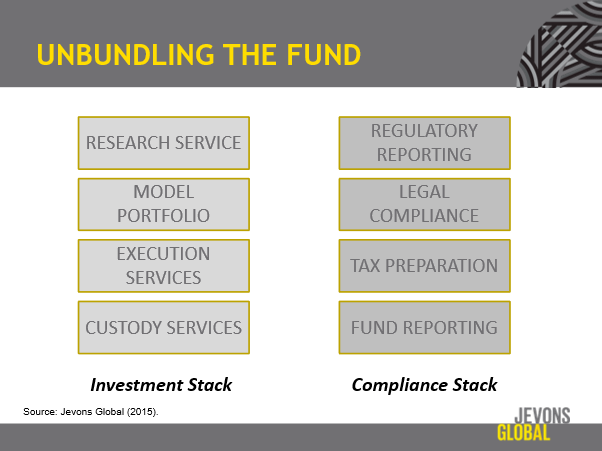
Following my early encounter with the Australian regulatory exclusion of the lower cost US RIA model, I pivoted to unbundled model portfolio services.
The managed investment fund was really created in the 1950s era when prosperity widened in the USA, and it became feasible to mass distribute investments. Mutual funds grew up in this era, and their uptake was accelerated by adoption of scale efficiencies from computing, in accountancy, trading and marketing.
If you consider the menu of services above, it was rational to bundle those together into a combined service offering, perhaps splitting investing and compliance from each other, since the left is more amenable to economies of scale.
The domestic growth of the SMSF industry, much like the US IRA and other savings vehicles for self-directed investment is one good example of this in action.
The problem for Australia, the one we are living through right now, is that because the Australian Securities and Investment Commission (ASIC) effectively shut down growth in Managed Discretionary Accounts (MDA), which is the local version of a US RIA, the industry naturally pivoted to raid SMSF funds for real estate investment.
In Australia, you do not need to be licensed to advise on real estate, and so there has been nothing to prevent advisers from latching on to debt hungry strategies they can market to retail investors in SMSF vehicles, in return for trailing commissions.
Australia has a habit of blowing itself up this way.
It is happening again.
The Pressure from Artificial Intelligence
When I first gave this talk Deep Learning had just broken onto the scene.
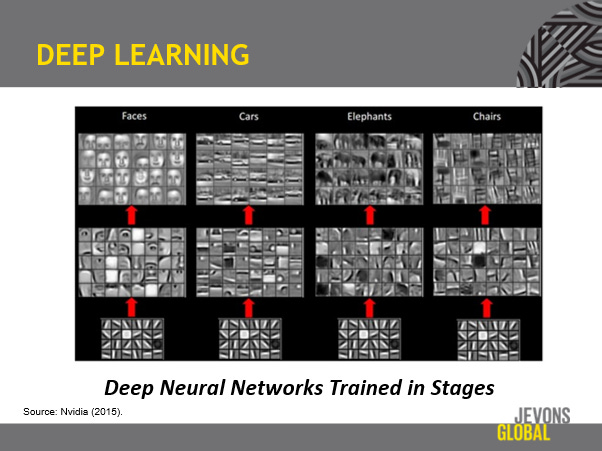
It is funny to think of how a seemingly innocuous development, like a new learning algorithm that scales well on video game hardware, can become a monster trend.
Ten years ago, the talk I gave was all about Big Data.
I spent more time talking about that…
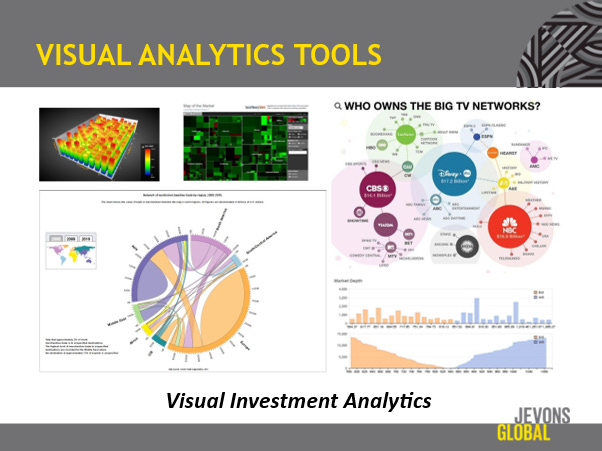
If you cast your mind back, ten or fifteen years ago, methods to tame, inspect, and analyze, massive data sets were at an absolute premium. Visual was the way to go.
This has changed now, since the textual input and output mode of the LLM, has given new and more flexible means to interrogate data in a natural human fashion.
The next wave is likely to be a better fusion of these two modes of understanding in more and better tools that combine both channels: readable text and visualization.
Humans are good at both gestalt “big picture” high bandwidth visual understanding and logical “down in the weeds” linear textual analysis. The advent of social media blurred those lines already. There are bigger opportunities ahead.
The Age of Massive Parallelism
This is not a piece on semiconductor design and architecture. I will say more about that in my look ahead piece to come, because I think it will change radically.
For now, it is enough to know that the Graphics Processing Unit (GPU) is ascendant.
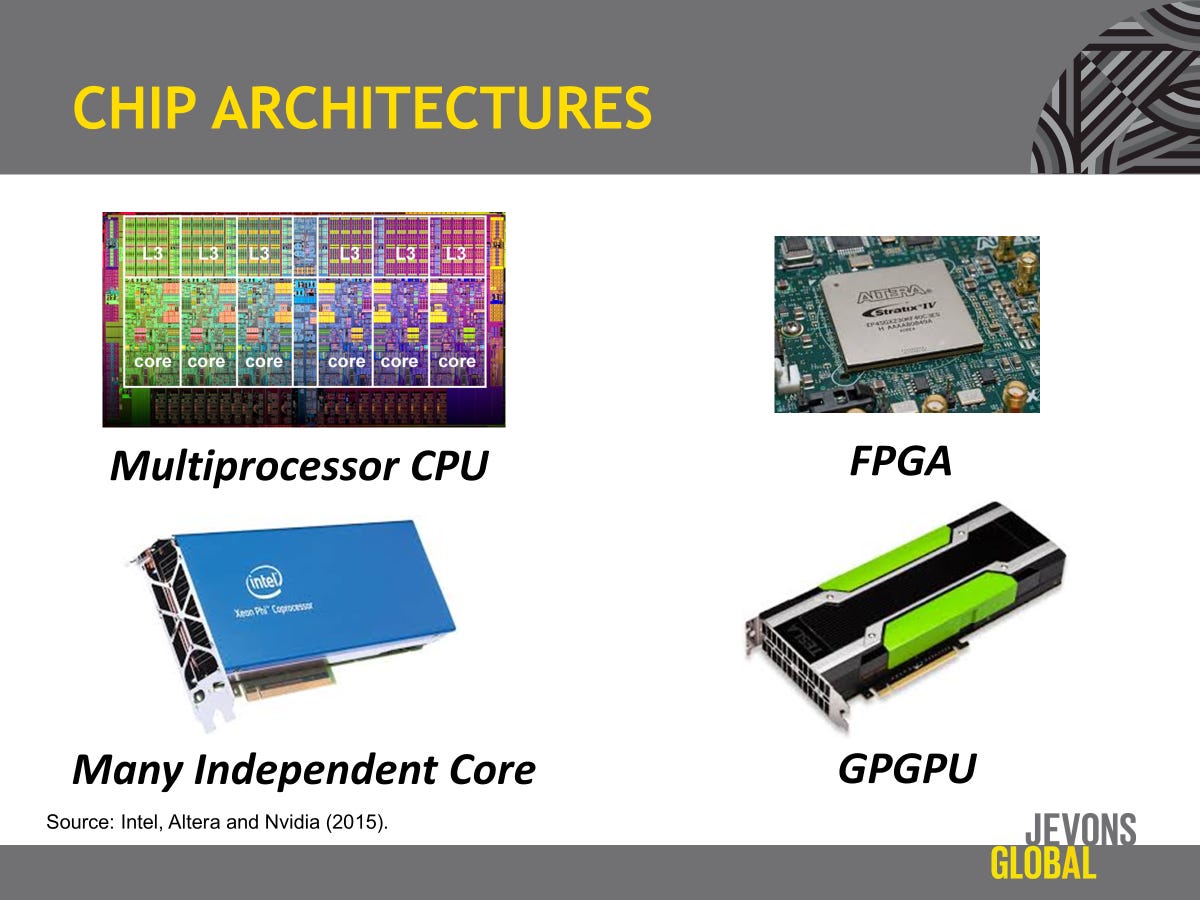
Earlier, I mentioned interest in visual analytics. I focused on this due to my experience with huge trading datasets based on tick data, individual trades and orders.
The above selection of chip architectures is informed by that background.
Almost nobody talks about Field-Programmable Gate Arrays (FPGA) today, but they have played a huge role in High-Frequency Trading (HFT), as a way to make custom hardware, in low production runs, for extreme low latency performance.
I will say more later, but this has a future in robotics, I am sure.
The top left architecture, the traditional many-core CPU now dominates with the GPU at lower left, but the key word is parallelism. When I wrote this my own lab had some examples of all but the FPGA, for evaluation purposes. The Intel MIC at lower left was junk, but I needed to know that, so I bought one cheap. It was junk.
What we have now is a computing world driven by two scaling laws.
The present headlines are dominated by the huge energy and cooling demands of the data centers that train and run Artificial Intelligence models in massive clusters.
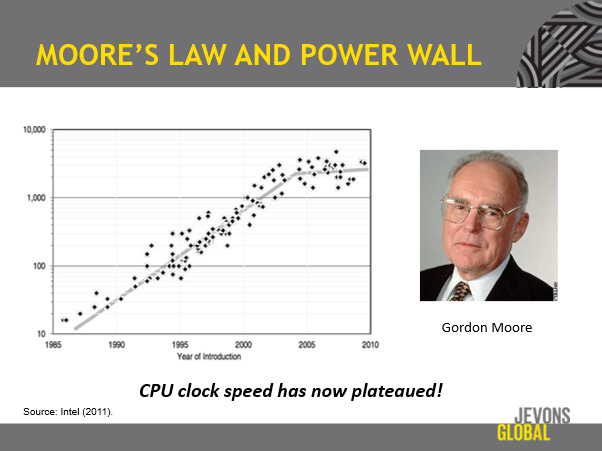
What drove computing up until about 2005 was the application of Moore’s Law on the number of transistors doubling every eighteen months or so in a model where finer chip features were met with a natural increase in CPU clock speed.
This model hit the wall with the death of Dennard Scaling.
In simple terms, the move to smaller features could not be met with an increase in the rate of computation via the simple device of increasing the clock speed. The chip die simply heated up more, and cooling became a problem.
The new route to enhancing throughput came via the little-known Amdahl’s Law.
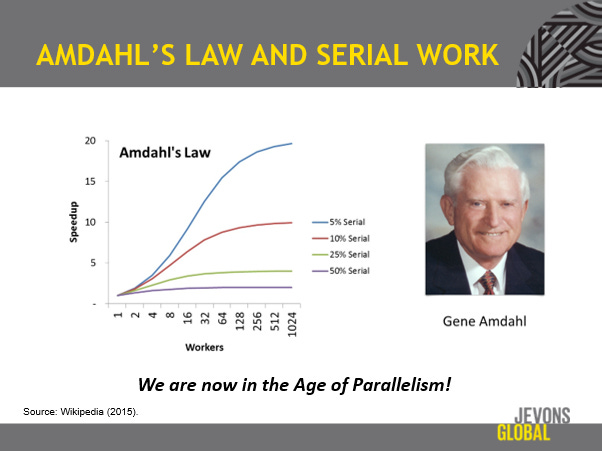
The essence of this scaling law is that the computing speed-up of adding more and more processing units is limited by the proportion of so-called serial work.
Serial work is the kind that cannot be broken up into separate non-communicating tasks. The factory analogy is final assembly of a finished product. You could readily speed-up manufacture of each part, but final assembly requires a mating of parts.
In a factory, you can do that by making more than one final assembly station.
The challenge with running very large AI models today is that Amdahl’s Law does limit the throughput from slow serial tasks. This is why innovations like Mixture of Experts (MoE) models from Chinese firm DeepSeek were rapidly adopted. Anything that can decouple workers from direct blocking communication can speed things up.
For a later discussion, I will mention Tau-Scaling from Huawei. This is a candidate new way to think about scaling computers to complement Moore and Amdahl. The jury is out about whether He’s Law (named for the CTO of Huawei) is the answer.
What we do know is that human intelligence takes about 1.3kg of grey matter, which occupies about 1,100 cubic centimeters of space (10cm cube), and consumes 20W.
There are folks that think current GPU’s are the final word in AI compute.
They are undeniably good, but I expect a replacement.
Business Models
The world of business models ten years ago portended where we are today.
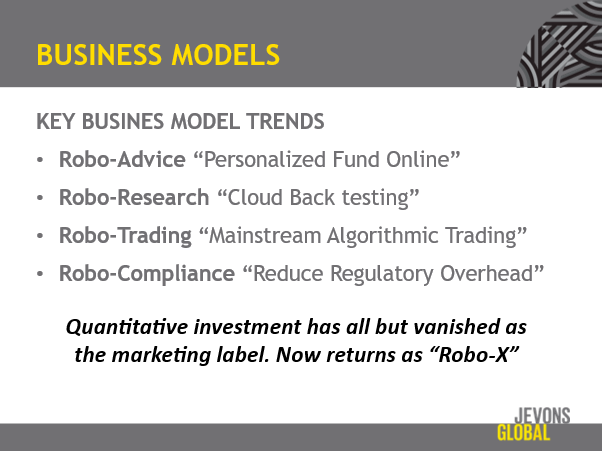
The key word is “Robo” and those trends now look to be accelerating.
The one point I would make here is that the biggest area I see for active application of Artificial Intelligence is accelerated volumes and tempo in digital marketing.
There is no need for a robot to be truthful to be an effective marketer.
Any obsession with factual outcomes is a handicap to closing the sale.
That might sound a little churlish, but it is what I think.
For these reasons, I have my own priorities for the journey ahead.
How can I apply technology to protect myself from unsolicited robot actions?
You know what I mean…
Imagine what happens when that call center that now bugs you every dinner time to sell you solar panels, a new mobile phone plan, or cheaper power, suddenly scales upwards by a factor of a thousand, to sweep more pennies to the bottom line?
That is one Yuga I can do without :-)
Conclusion
That was a ten-year rear vision mirror view.
Having spent this afternoon reviewing what I used to think, I have come to the not very surprising conclusion that the future will bring more automation.
However, I also think there will be a further decline in manifest corporate expertise.
It has been my experience that corporations get dumber over time.
I expect this condition to accelerate under the pressures of A.I. adoption.
This will likely lead to opportunity, but one needs to protect oneself.
I think the new direction is more self-directed investing.
The business direction of Jevons Global is in flux, but I think I am likely to double down on research services and open-source investment systems.
High-performance computing is now super-abundant at falling cost.
Previously, I thought of selling such services to other people. Now the cost to produce the service is so low, that the better application of it is to my own portfolio.
I could make zero dollars by selling the service or I could make a decent return on my own capital applying that internally. The second option is the rational one.
However, as is true of my scientific activity, the only way to keep yourself honest is to put your thoughts, observations, and creations before others for critique.
That is the upshot of this personal reflection.
Stay tuned for the detail of what comes next.
Happy investing!