


The best antidote I know to the Fear of Missing Out (FOMO) is the confidence to know that you are not missing out on much. This investment cycle looks close to working itself out in the standard fashion: too much debt, too high interest rates!
This has already started in Australia, where the housing downturn seems to have accelerated in the last month. The newspapers are full of folks to blame.
Downturns and recessions are normal.
They clear excess and reset the Animal Spirits towards real opportunity.
I do not know if Australia will experience a recession in 2027, but it looks possible due to the extent of household indebtedness and too high land values across the nation.
Excess focus on the extraction of rents from rising land values is a peculiar disease of debt based monetary systems. It is unlikely to go away anytime soon.
In my lifetime, there have been four major recessions in Australia.
1973–75
1982–83
1990–91
2020
The COVID recession of 2020 was the odd man out.
All of the others related to the standard business cycle of slump, recovery, the slow rebuilding of confidence, followed by expansion, the emergence of rising prices due to capacity constraints, capital investment to address those, followed by exuberance, excess, rising interest rates, and a renewed slump. We are following the script.
Those under fifty years old will find this view quaint, old-fashioned and wrong.
I know that which is why I am waiting for the inevitable to happen.
Disbelief that anything bad could ever happen is the defining state of mind of any decent market top. It is what will drive the Firmus IPO to a decent stag on open.
Firmus, which is in the market to build data centres to serve Artificial Intelligence and has a claim to more energy efficient patented immersion cooling, is the poster child every late cycle market impulse needs. It is the too good to be true story.
No element of the Firmus story is wrong, but I am not buying it.
The reason I have no FOMO on Firmus relates to the pace of capital expenditure, in the Artificial Intelligence race, compared with the industry state of maturity.
The presumption of our time is that Artificial Intelligence is a “race” which will be won by whomever spends the most money the fastest. The idea is that superintelligence is the prize, and anybody who achieves that will sweep all else before them.
This race is about World Domination, and you want to win the race don’t you?
Actually, no, I am not even in that race. I am part of the human race.
There are so many ways that this race is stupid beyond comprehension that I have chosen to write about the personal race I am running, right now, in which I see no credible competition anywhere on the planet at this moment in time.
This note is about the power of the human mind.
You have one, so you should be interested!
Welcome to my world of functional hybrid intelligence. This is the world we are all trying out for size, where we use depth logical search to follow our own muse.
The Collective Failure of Imagination
I have been in markets for three decades, so I can opine on the one feature of them that I can absolutely count on to make me money in each and every cycle.
The financial market is a place where this time is different every time it is not.
This is the cycle of greed that harvests the human fear of missing out on a feast.
There is a feast on offer right now, and participation can be had for free. I have been partaking of this feast, to advance my own projects, without paying a dime.
The mythology of our time is that the present generation of computers represent the pinnacle of what is achievable against the metrics of performance, energy, time and space. This is why control of the global compute supply chain is a superpower race.
I know enough about the history, theory and practice of computing to know that this is definitely not the case. Presently, I am writing this using my own personal wetware that runs on coffee and Vegemite toast, occupies around a 10 cm cube in space, weighs about 1kg and uses about 20W of power. How puny is that!
For you to read it, I am typing at my PC whose CPU is at 1% utilization, running at between 1.2GHz and 3.5Ghz depending on when I type with a quiet pair of GPUs.
There is almost no electrical power being consumed to write this note.
The greatest power consumption I can see is likely the light above that I see by.
Presently, my brain is using about the same power as it does whenever I make a major mathematical or physical discovery. There is almost no difference that I can determine between the power consumption of my brain at peak performance versus that when I am sleeping. In truth, I do my best thinking when I am sleeping.
When I wake up in the morning, I write down what I discovered that night.
This is the miracle of the human mind, which can master Zen mind, which is no mind at all. Every one of us has that latent power. We were born with it.
The true power of the human mind is boundless imagination.
The reason that nighttime thinking matters so greatly to creative pursuits is that this is the time when dreams are active, and they manifest the active imagination.
Albert Einstein put it succinctly.
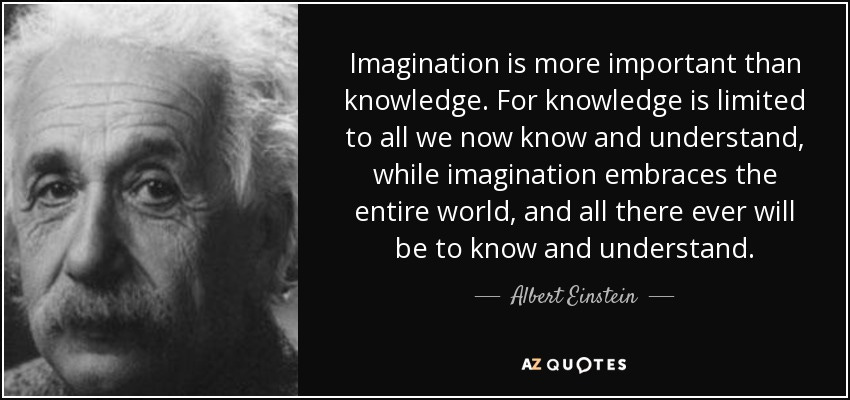
The importance of human imagination cannot be overstated and is the key to hybrid intelligence. There are always two minds at work in our brains.
Mind one has Gestalt Vision and frames the imaginative question.
Mind two has Logical Search Depth and verifies the answer to our questions
This is just how things are, no matter how poorly the situation is articulated in schools, the workplace, or the halls of power. What matters is the generation of questions.
I am told that there is a crisis of critical thinking. Supposedly, the human capacity to frame and pose critically searching questions has atrophied. Perhaps it has, but I do not think this is down to any deficiency of capability. It is simply a lack of will.
Discovery is an Act of Will
Earlier, I mentioned that I am gorging on free supercomputing power as the different vendors of Artificial Intelligence systems compete for my total attention. I have yet to spend any money at all buying such services, except for electricity.
It is a funny situation.
Every night I go to bed, complete with a working brain that has chewed over many new and interesting questions these past sixty years. I do not seek answers to the questions, but assistance with their interconnection. This is called synthesis.
The human mind has a remarkable capacity for synthesis. Experientially, synthesis is very different from analysis. The latter is step-by-step, laborious, detail-oriented, and quite tedious to complete. It is the checking of a thesis, to see if it holds water. The opposite of this process, is the framing of the thesis, which happens instantly.
You know this process already: It is the A-Ha Moment!
True insight happens all at once, and takes no perceptible time or effort.
This is what the human mind excels at, provided we are prepared to let it.
Since my mother was an artist, I became familiar with the art of seeing at an early age. She would explain that the act of drawing was about learning to see.
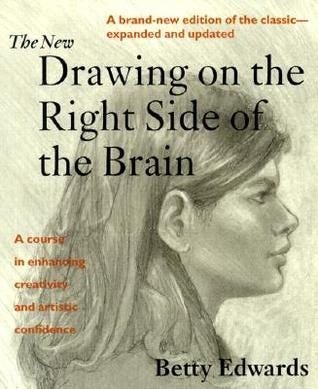
Like most schoolchildren, I swallowed the line that drawing is some kind of magical ability that you are born with, or not, and entirely non-teachable.
This is nonsense of the kind you teach children to prepare them for a world of linear thinking, where everything is done in clear steps, following strict rules of logic.
It is useful to be able to reason logically, and that is my forte.
I am a mathematician and so know how to reason from a priori assumptions.
However, this has never how I have done good mathematics.
Good mathematics is the creation ex nihilo of new productive axiom systems.
You do not derive new mathematics. It comes from another place entirely: the active imagination. It will brew awhile, in splendid obscurity, and then “poof” you have it.
Here is an example of that process.
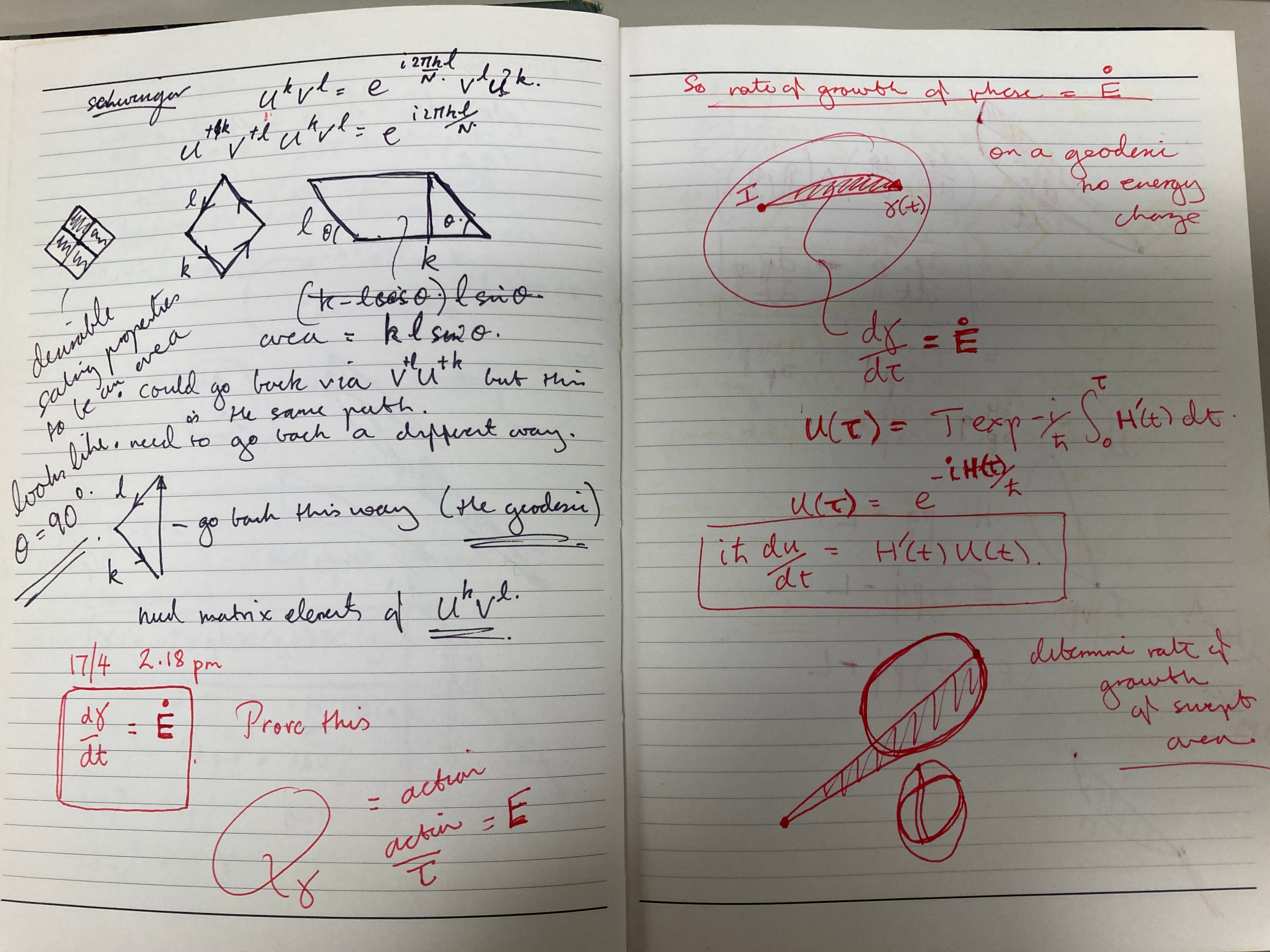
Like anybody, I keep notebooks to jot down ideas and work them out. Whenever I do theoretical physics, I use reams of paper to grind out calculations. Inevitably, there are mistakes, and so I typically redo my calculations until I have it all straightened out.
I have enough of these notebooks, accumulated over forty years, to know the pattern of discovery and invention. The invention stage always starts with a marginal note. On the above page, you can see a very short note, dated, with a comment: Prove this.
There is some other stuff there, in a mix of colors, depending on what pen was lying around, some diagrams, which are not explained, and a boxed equation.
This was the origin of my 1991 discovery of the Classical Schrodinger Equation.
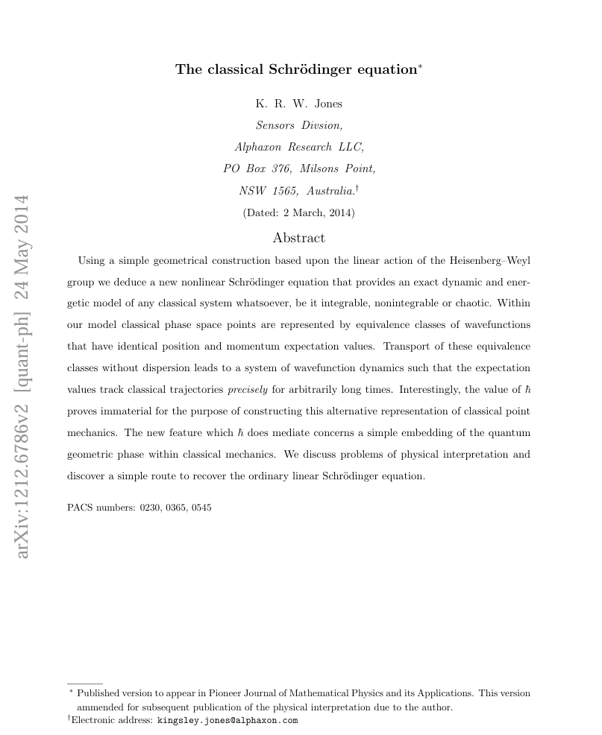
What you see above is the final result, after filling in the gaps, doing a lot of work on the physical interpretation, and checking of the mathematics.
The mathematics turned out to be new.
What you have above is the first example of Projective Hamiltonian Mechanics, a type of dynamical system that was not previously known to mathematics.
This mathematical system is not supposed to exist.
There is a celebrated no-go theorem called the Groenewold-Van Hove theorem which ought to tell you that Kingsley Jones simply cannot do what he has already done!
The Groenewold-Van Hove theorem is a fundamental "no-go" theorem in quantum mechanics and mathematical physics proving that it is impossible to construct a consistent, fully general quantization map from all classical observables to quantum operators.
This is a 100% correct but sadly irrelevant mathematical theorem.
The Groenewold-Van Hove theorem makes the assumption that the algebra that is used to construct such a system is associative. This means that:
The mathematics that I developed, in the course of elaborating my discovery, turned out to be non-associative. It neatly side-steps the assumptions of the GvH theorem.
My purpose here is not to belabor a point in mathematical physics.
The point is as follows:
The necessary branch of new mathematics, which I call projective differential geometry, was only accessible by making an intuitive leap. The logical path to this discovery had long ago been boarded up as being an impassable road.
The person who makes the leap to a new discovery exercised their will power to go look where none had looked before. If you can see, you can look in new places.
Superintelligence entails the will to look where no other has looked before.
Look and you will find, if there is something to be found in that place you look.
This is why Albert Einstein was precisely correct in his assessment.
Imagination is more important than knowledge.
It is true, that the LLM has unleashed much potential from the interrogation of all human knowledge in question and answer form.
What matters is what new question you pose to the LLM.
The discovery above is one example of that process in action. In isolation, it matters little, but the iceberg it disclosed is massive. The underlying mathematics is rich and leads in unexpected directions. It remakes differential geometry, and with it the relationship between complex numbers and hypercomplex numbers.
What started forty years ago as a curiosity is now a viable pathway to a new physics that is fundamentally about kinematics and dynamics on projective spaces.
What is the “Hybrid” in Hybrid Intelligence?
There is a saying “to be in two minds” when deliberating on a course of action.
This is a metaphor for two distinct modalities of thinking. These are ratiocination, or the deliberative step-by-step process of reasoning things through, or the insightful path of recognizing what is truly new and novel about any given situation.
It is a truth of neurobiology that brains, human or otherwise, come in two parts:
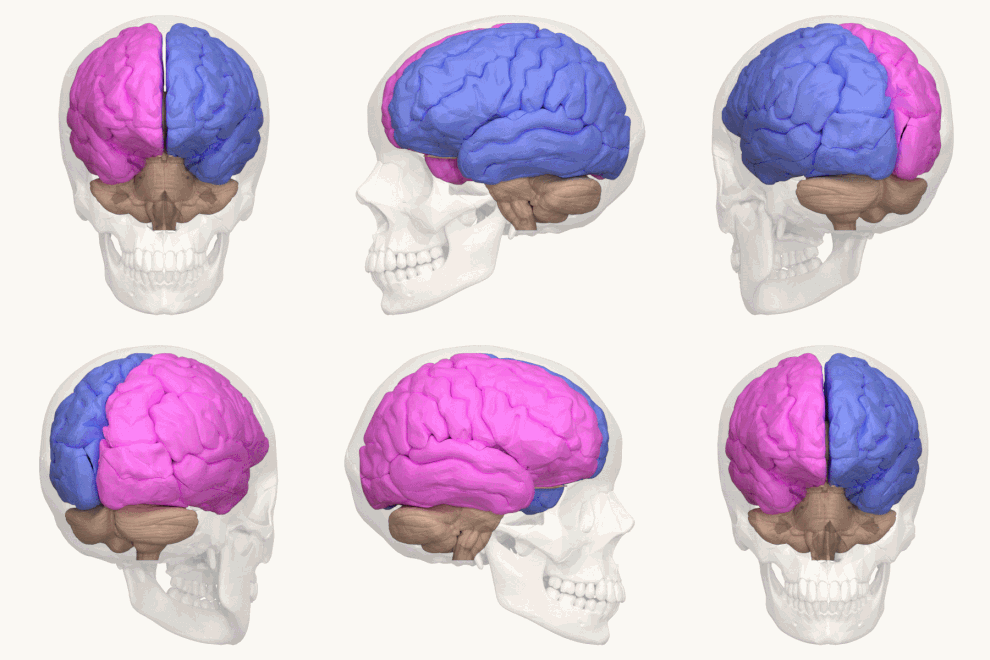
The two hemispheres of the human brain approach tasks differently. The left brain is good at analysis, while the right brain is good at synthesis. We need both.
The present LLM trend emphasizes a Q&A style of discourse.
The presumption is that “intelligence” is rooted in the A: the Answer. However, there is just as much intelligence, possibly more, in framing Q: the Question.
Creative pursuits in mathematics and science involve framing good questions.
If you ask a new and novel question you can do good science.
The sum total of my life’s work in mathematics and physics was one good question:
How do kinematics and dynamics look when reframed in projective geometry?
This is not the declarative “Answer” style of discourse like: The Universe is made of strings! This is the “Question” style of discourse: What does dynamics in projective geometry look like? I am well on my way to answering that new question.
Conclusion
The reason that I think LLM technology is not the final word in Artificial Intelligence relates to the incompleteness of the conception. There is too much emphasis given towards knowledge, and not enough to the creative spark of reason. Certainly, this technology is very useful. However, it did not pose the question I framed above.
The “Hybrid” in Hybrid Intelligence is the ability to see both sides of the coin.
New discoveries flow from well framed novel questions.
The exhaustive search and checking of conclusions is valuable, but not as important as it first seems. The really critical step is that new step on a road not taken.
There is no essential physical reason why artificial intelligence cannot achieve this level of integration, but the present form appears lacking in this respect.
This is not a problem, as any intelligent human can plug that yawning gap.
We know that we can because the LLM brigade learned everything they know from us by being trained, in greedy stepwise descent fashion, on the fruits of our thinking.
This is no terrible thing if you know what to do with your mind.
Ask the probing unasked question.
Happy investing.