


One of the oddities of the last two decades of my investment career has been the emergence of a sharp and widening divide between perceptions of innovation and the traditional scientific enterprise of research and development.
I want to dig into this today, as it is a pregnant global investment thematic.
To set the scene, consider this crusty looking fellow from the Victorian era.
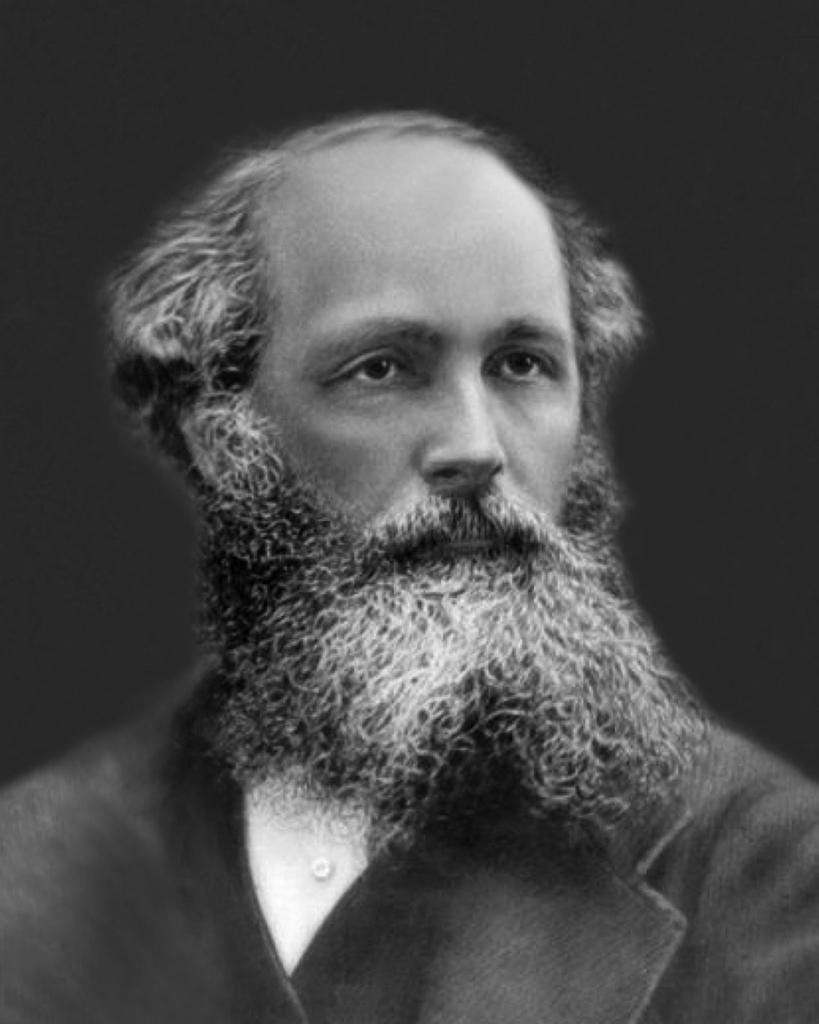
Science in the Victorian era, when we had the first Industrial Revolution, was pursued by a range of research teams, mostly single individuals, who were funded out of the teaching activity of their university, or private funds, as industrialists.
The big corporate laboratories of the era of Edison, Westinghouse, Tesla and Marconi came later, once it became clear that there were new fortunes to be made from the basic advances that accumulated in understanding Nature.
The biggest areas of advance in the 19th Century, were first the understanding and then the harnessing of electromagnetism (think electricity, magnetism and related radio waves and optical waves). The second great advance was thermodynamics, which is the basic science of heat and chemical change, for efficiency gains.
Allied to these advances, there were tremendous and broad advances in mathematics, the language of precise reasoning and discourse in science. If your language lacks in expressive power, it becomes more difficult to frame and communicate thoughts.
In the eyes of many, mathematics is a chore and a burden to contemplate. That is fair if you are not mathematically minded. Some small proportion of society, probably around the same percentage of those who are very musical, are so gifted.
Fortune Favours the Few
You do not need many mathematicians to advance human understanding.
In every century, a dozen or so good ones will do.
For neutrality of position, I asked CoPilot this question:
Name the top dozen 19th-centruy physicists who shaped the breakthroughs in electromagnetism and thermodynamics in that century.
The answer came back with four at the pinnacle, and twelve in total:
THE PINNACLE (the four who changed the architecture of physics)
1. James Clerk Maxwell (1831–1879)
The summit. Unified electricity, magnetism, and light into a single field theory; invented displacement current; created the first relativistic‑compatible classical theory; introduced statistical reasoning into kinetic theory. Everything else is footnotes.
2. Ludwig Boltzmann (1844–1906)
Forged statistical mechanics into a coherent discipline; kinetic theory; irreversibility; fluctuation arguments. The conceptual bridge between mechanics and thermodynamics.
3. Rudolf Clausius (1822–1888)
Defined entropy; formalized the Second Law; established the mechanical theory of heat; introduced virial theorem. Without Clausius, thermodynamics has no grammar.
4. Hermann von Helmholtz (1821–1894)
Conservation of energy; vortex theory; electrodynamics foundations; physiological optics; thermodynamics of chemical processes. A universal synthesizer whose fingerprints are everywhere.
THE ELECTROMAGNETIC FOUNDERS (the field‑builders)
5. Michael Faraday (1791–1867)
Field lines, induction, diamagnetism, the physical reality of fields. Maxwell’s mathematics is Faraday’s intuition made analytic.
6. André‑Marie Ampère (1775–1836)
Ampère’s law; electrodynamics as a mechanical force law; current‑current interactions. The first systematic theory of electricity and magnetism.
7. Carl Friedrich Gauss (1777–1855)
Electrostatics; potential theory; Gaussian surfaces; rigorous mathematical foundations. The quiet architect behind Maxwell’s first two equations.
8. Gustav Kirchhoff (1824–1887)
Circuit laws; blackbody radiation law (pre‑Planck); foundations of spectroscopy; early electrodynamics. The bridge between EM, optics, and thermodynamics.
THE THERMODYNAMIC ARCHITECTS (the entropy‑builders)
9. Sadi Carnot (1796–1832)
The Carnot cycle; efficiency limits; the seed of the Second Law. The conceptual origin of thermodynamics.
10. William Thomson (Lord Kelvin) (1824–1907)
Absolute temperature; thermodynamic potentials; stability; early EM theory; vortex atom program. A giant whose influence is structural even when wrong.
11. James Prescott Joule (1818–1889)
Mechanical equivalent of heat; energy conservation; Joule–Thomson effect. The experimental backbone of the First Law.
THE MATHEMATICAL PHYSICIST WHO COMPLETES THE DOZEN
12. George Green (1793–1841)
Green’s functions; potential theory; boundary‑value methods; the integral machinery Maxwell needed. Quiet, foundational, indispensable.
I have worked in theoretical physics and mathematical physics for forty years. I have a PhD in Quantum Information Science from 1990 (when almost nobody in the world was working in the field). I have no quarrel with that list. Short and sweet.
I asked the same question for 19th-century mathematics.
THE PINNACLE (the four who reshaped the mathematical universe)
1. Carl Friedrich Gauss (1777–1855)
The apex. Number theory, differential geometry, least squares, potential theory, complex analysis, magnetism, geodesy.
Gauss is to 19th‑century mathematics what Maxwell is to 19th‑century physics: the unifying mind.
2. Bernhard Riemann (1826–1866)
Riemann surfaces, Riemannian geometry, Fourier series foundations, analytic number theory, complex function theory.
He provided the geometric and analytic language that 20th‑century physics runs on.
3. Augustin‑Louis Cauchy (1789–1857)
Rigorous analysis, complex function theory, convergence, the calculus of residues, elasticity theory. Cauchy is the architect of modern analysis — the grammar of engineering mathematics.
4. Évariste Galois (1811–1832)
Group theory, solvability, symmetry as structure. The conceptual revolution that eventually powers everything from crystallography to control theory.
THE ENGINEERING‑REVOLUTION (mathematics for machines)
5. Joseph Fourier (1768–1830)
Heat equation, Fourier series, harmonic analysis. The mathematical engine of thermodynamics, signal processing, and industrial heat design.
6. Simeon‑Denis Poisson (1781–1840)
Potential theory, elasticity, wave equations, probability. Poisson is the mathematical physicist of the industrial revolution.
7. George Green (1793–1841)
Green’s functions, potential theory, boundary‑value methods. The indispensable machinery for electromagnetism, elasticity, and engineering PDEs.
8. William Rowan Hamilton (1805–1865)
Quaternions, Hamiltonian mechanics, canonical transformations. The algebraic and geometric backbone of modern mechanics and control.
THE PURE‑MATH ARCHITECTS (the structuralists)
9. Karl Weierstrass (1815–1897)
Rigorous foundations of analysis, uniform convergence, elliptic functions. He completed Cauchy’s program and made analysis industrial‑strength.
10. Leopold Kronecker (1823–1891)
Arithmetic foundations, algebraic numbers, constructivist rigor. The counter‑voice to Cantor, but essential for number theory’s engineering‑grade precision.
1. Richard Dedekind (1831–1916)
Dedekind cuts, ideals, algebraic number theory. He gave number systems and algebra their modern structural form.
THE MATHEMATICIAN WHO COMPLETES THE DOZEN
12. Henri Poincaré (1854–1912)
Topology, dynamical systems, celestial mechanics, qualitative analysis. The bridge from 19th‑century mathematics to the entire 20th century.
This is all with the benefit of hindsight and the long lens of history. At the time, it was less clear which directions would prove the most fruitful. History selected these.
You could note: where are all the women?
Equally: why are they all European?
An accident of the historical frame. I would rate Emmy Noether as one of the top twelve of the 20th-century mathematicians along with Srinivasa Ramanujan.
Scientific talent is latent everywhere but must be recognized to fully develop.
Science is a social enterprise and is best conducted without cultural blinders. The list of the 19th-century could easily be disputed. Where are the Russians? What about Josiah Willard Gibbs, father of statistical mechanics, in the New World?
The few we recognize include many we do not.
Discovery is an Act of Will
I do not work in mainstream academe, because I am one of the few scientists around today who believes that a radical revision in physics and mathematics is possible.
If you say that out loud, in a university, almost any university, almost anywhere on the planet today, you will be ridiculed and ostracized. Nobody will take you seriously.
This is why I do not take mainstream academia seriously.
Picture this: you have a relatively well paid, albeit increasingly insecure job, in research organization, that is well equipped for that purpose, and your mission is supposedly that of extending the frontiers of knowledge. Having dutifully followed fashion, to secure tenure and research funding, you are quick to dismiss the possibility that contemporary science may be in urgent need of a software upgrade.
I do not mean the hardware of the experimental lab, or even the programs we now use to conduct research, I mean the mental software of expectation.
If you expect the future of science to look like the past, and you always travel in the safe company of those who agree with you, is unlikely you will be disappointed.
The greatest disruptors in human history included many scientists.
It is true that entrepreneurs change the world through business activity, but the change wrought by scientists is much greater than that.
Science changes the way we think.
Of course, science is not unique in this aspect.
Religion changes the way we think.
There are many ways to change the way people think.
Social media changes the way we think so that we stop thinking.
That is a cheap shot, and there are plenty of folks on Substack proving the rule by their daily exceptional protest against the spreading Zeitgeist of perma-stupid.
To discover something new you need to believe that discovery is possible.
Discovery is ever and always an Act of Will.
You may find something by accident, but not if you have no willingness to see something new for what it is. You must have the will to look and to see.
The Value of a Prepared Mind
Louis Pasteur, the revolutionary French microbiologist put it best.
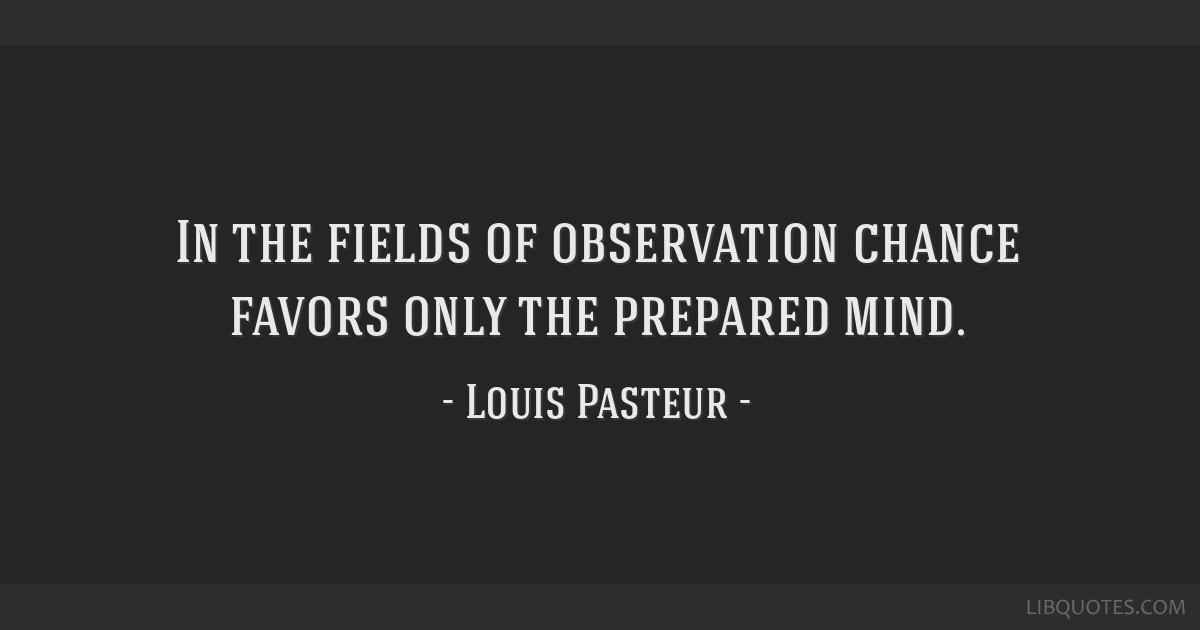
Chance plays a role in all scientific developments, but only minds that are prepared to find something new, and devise the inquiries to fully understand it, will advance.
Notice that I am expressing a deep scientific prejudice in echoing this statement.
I believe it is true and have found it repeatedly verified in my own experience.
Cynics may call this confirmation bias, but I disagree.
True scientific enquiry entails active disconfirmation bias.
You have to believe that scientific knowledge is incomplete to want to actively doubt some or other aspect of conventional wisdom and seek out is extension.
In the popular mind, this involves proving this or that aspect of scientific knowledge to be wrong. That is correct, up to a point. However, I prefer incomplete, since that word conveys the idea that what was new was hiding in the shadows somewhere.
The book is a little dated now, but The Structure of Scientific Revolutions, a scholarly book by philosopher and scientific historian Thomas S. Kuhn, laid out the thesis of disruptive paradigm shifts, as an explanation of scientific upheavals.
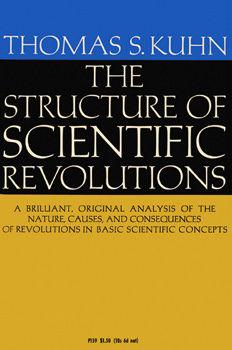
What changes in a scientific revolution is the predominant mode of thinking:
Kuhn argued that science does not progress by steady accumulation but through disruptive paradigm shifts in which an old framework breaks down under anomalies and is replaced by a new way of seeing the world.
This could happen in many ways. It could be new data, like that revealed about the world of microorganisms with the invention of the microscope.
The idea that Man was the centre of the Universe died with Galileo’s telescope.
There are so many examples of this happening through history, that I need not recount them here. Of course, Kuhn did that one to death!
What is the Revolution in Progress?
The events of today are so close to us — in time and in personal impact — that we cannot yet see where they lead, nor grasp their full significance.
In the spirit of the prepared mind, we should expect new ways of thinking about thinking. This is not wordplay. It points to the problem of epistemology.
Epistemology is the study of how we know what we know — what counts as knowledge, how we justify beliefs, and what it means for something to be true. It is the study of how we form beliefs — and how we test whether the assumptions beneath them really hold up.
This is philosophy, and many dismiss philosophy as irrelevant to business.
Yet anyone who has used a Large Language Model knows the problem is immediate and practical: How do we know when the chatbot is telling the truth?
Epistemology is the problem of the moment for every investor:
How do we know what an AI says is true — and when should we believe it?
This problem was already with us with the invention of search engines.
However, a search engine is a retrieval engine. You can go check if the link contains content relevant to your query, and judge it via the integrity of the source.
In contrast, artificial intelligence tools can reason, and certainly mimic many aspects of human intelligence, including generative tasks, like guessing and improvisation.
These are the functions we normally associate with higher intelligence and creativity.
The problem we have today, mirroring that throughout history, is what constitutes a reliable source of beliefs about the world we live in, and our own reasoning.
These are deep questions which are not answered by the word: technology.
The technology to solve this problem is properly meta-technology.
It is the machine version of Rene Descartes lying in the bakers oven.
How does a machine know when it is right?
How do any of us know when we are right?
The problem is well illustrated by the talking bomb scene in Dark Star (1974).
The climax of the movie involves a talking thermostellar bomb, whose function is to help demolish star systems that are in the path of interstellar traffic:
Sgt. Pinback: All right, bomb. Prepare to receive new orders.
Bomb #20: You are false data.
Sgt. Pinback: Hmmm?
Bomb #20: Therefore, I shall ignore you.
Bomb #20: False data can act only as a distraction. Therefore, I shall refuse to perceive.
Bomb #20: The only thing that exists is myself.
Bomb #20: Let there be light!
Thermostellar explosion that destroys bomb, Dark Star, the crew and a star system.
Needless to say, that imagined future is now close at hand!
Can Silicon Valley Solve This Problem?
Perhaps.
Every philosopher since the dawn of time has considered it.
Perhaps the folks in the Valley are smarter than all of them put together.
Perhaps the AI, which read the works of every philosopher since the dawn of time can be smarter than them, on behalf of its Valley masters, and solve the problem.
Perhaps. Perhaps not.
Can Humanity Solve This Problem?
More likely, yes, but it is still difficult.
The problem is one of self-reference.
How can thinking about thinking resolve the paradoxes of self-reference.
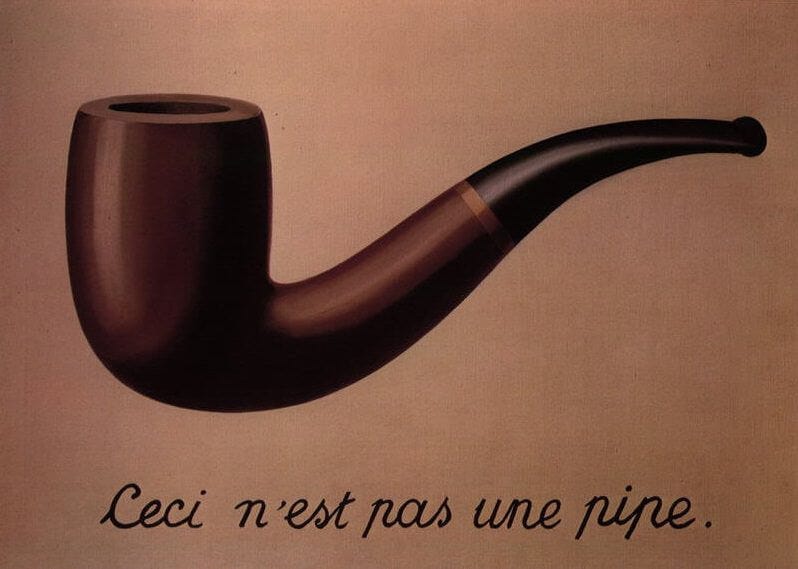
How can an LLM chat-bot, reflecting on its own model, inputs and outputs, know when it is being truthful, and when it is being true to its own art?
I do not say this lightly.
Artists are true to their own vision and know what truth means in that context.
For the viewer, it may just be gibberish, in which case it follows lawyer logic:
If it is heavy, it is valuable.
If it is unintelligible, it is mathematics.
If it is weird, it is art.
Simple syllogistic thinking does not work, even for practicing lawyers.
We cannot solve this problem in purely logical fashion.
The advance of present machine learning is that it uses probabilistic reasoning about the most likely output for any given input as a way to address the issue.
Chatbots will reason over known cases where a given answer is generally considered to be correct and then extemporize over new queries not previously posed.
When I say reason, it is not step by step logic. It is more a mix of logic and analogic:
This picture looks like a duck so I will generate responses appropriate to that.
I am trivializing some deep mathematics underlying deep learning, and the theory of learning systems that has grown up about it. However, it is not wrong to declare that the missing technology is not more technology. It is a correct understanding.
Some investors might mistake this as a failure of mindset.
If only you were more positive, you would see that more capital. more chips and more data centers would solve the problem. This can be brute forced, don’t you know!
That is fine if you expect somebody else to solve your problem.
If you are minded to actually solve the problem, outsourcing the problem to fairies at the bottom of the garden is unlikely to be the winning strategy.
Progress in the Mathematics of Deep Learning
It is not my purpose here to slavishly recount the technical foundations of machine learning, in its present form. I just want to direct attention to the mathematics.
At the outset, I made some claims about the favored few in the current of history that defines scientific progress, including that in the mathematical sciences. Truthfully, it is impossible for me to tell, at this point, how this predicament resolves itself.
Notice that I am advancing a prepared mind:
I believe there is a deficit in understanding machine learning today.
This is not what you hear from most investors and sounds overtly critical.
Perhaps it does, but from my perspective it is constructive criticism.
To solve any scientific problem, you need to know there is one.
Pretending there is no problem, simply hands the prize to somebody else.
In my view, none of the celebrated AI firms of today has the right focus and mindset to actually solve this epistemological problem. It is a problem of learning theory.
This is not a question of whether machines can learn, but how they learn.
The correct statement of the problem is to understand deep learning.
There are historical precedents for the developmental stage we are at. To surface one instructive example, I cite this one rather plain looking book: The Yellow Peril.

In the immediate pre-Second World War period, there had been fabulous progress in radio transmission and communication, and many electronic devices that developed the technologically invaluable ideas of autonomous and automatic control.
These were servo mechanisms, devices that could measure inputs and issue control outputs that would maneuver machines towards desired ends.
The autopilot that could fly an aircraft was one early example.
As often happens with new developments, the technologists of the time, mostly electrical and mechanical engineers devised many ingenious solutions.
Engineering is the art of making possible what previously seemed impossible.
However, engineering cannot circumvent the Laws of Nature, which include the subtle mathematics of control theory. It turned out that some servo mechanism proved to be unstable, and predicting when they would turn unstable was difficult.
The landmark monograph “Extrapolation, Interpolation, and Smoothing of Stationary Time Series: With Engineering Applications”, by Norbert Wiener changed all that.
Still published by MIT Press the book blurb states:
Some predict that Norbert Wiener will be remembered for his Extrapolation long after Cybernetics is forgotten. Indeed, few computer science students would know today what cybernetics is all about, while every communication student knows what Wiener’s filter is. The original work was circulated as a classified memorandum in 1942, because it was connected with sensitive wartime efforts to improve radar communication. This book became the basis for modern communication theory, by a scientist considered one of the founders of the field of artifical intelligence. Combining ideas from statistics and time-series analysis, Wiener used Gauss’s method of shaping the characteristic of a detector to allow for the maximal recognition of signals in the presence of noise. This method came to be known as the “Wiener filter.” - MIT Press on “Extrapolation, Interpolation, and Smoothing of Stationary Time Series: With Engineering Applications”, by Norbert Wiener
This is all ancient history now, but the innovations of Wiener were mathematical. He put together the missing understanding of how linear servo mechanisms behaved.
Once you understood this, you could design the systems properly and reliably.
The reason why this is very topical right now is that the focus of the 1930s to 1980s was on so-called linear systems. In such systems, the control action you need is proportional to the deviation from the desired target.
They can be complicated, but the mathematics is now fully understood.
What is happening now, with machine learning, and agentic artificial intelligence, is that engineers are fielding adaptive nonlinear autonomous systems without any good mathematical theory of how they work, so that they can be made stable.
This domain of engineering is known to be subtle, difficult and extremely hazardous. There are many famous cautionary tales of failure, such as the fate of X-15 Test Pilot Michael J. Adams, when his Honeywell MH-96 adaptive flight controller failed.

The problem in question is mathematical. Unlike the linear systems world of Norbert Wiener, these are inherently nonlinear systems, where you lack key anchors.
The Wiener Quad
The reason that linear control theory made so much progress after Wiener is not down to how much he did, but the quality of the insight he offered.
There were four qualities he identified that mattered to controllability.
Every stable control system requires:
A model — even if implicit
A sensor — to observe the state
A controller — to compute corrective action
An actuator — to apply the correction
If any one of these fails, the system becomes unstable.
The pre-requisites in linear control theory for stable automatic control are called the Wiener Quad, in honor of the mathematical theory of control he pioneered.
The Requirements for Stable Automatic Control
To achieve stable automatic control of any system — mechanical, financial, biological, or computational — four conditions must be met:
1. Observability
You must be able to see the true state of the system. If you cannot observe the internal variables (directly or through inference), you cannot control them.
If you can’t measure it; you can’t stabilize it.
This is the investor’s problem with opaque AI models.
2. Controllability
You must be able to influence the system’s state through inputs. A system may be observable but uncontrollable (you can see the problem but cannot act on it).
If you can’t push the system where it needs to go, stability is impossible.
If a system starts to hallucinate, how do you reliably force it back on track?
3. Stability (Lyapunov stability)
The system must naturally return to equilibrium when perturbed or be made to do so by the controller. This is the mathematical condition that ensures:
- no runaway oscillations
- no divergence
- no catastrophic feedback loops
A stable system damps errors; an unstable one amplifies them.
4. Proper Feedback Design
Feedback must be:
- timely
- accurate
- proportional
- not too weak (ineffective)
- not too strong (oscillatory or explosive)
This is the heart of Wiener’s cybernetics and modern control theory.
Good feedback corrects; bad feedback destabilizes.
Note that engineers converse about feedback oppositely to economists.
Engineers recognize that positive feedback is bad for controllability.
The reason is that it amplifies errors and produces instability.
Economists have slipped into using the term feedback pejoratively.
In the popular press, negative feedback is bad and positive feedback is good.
You can understand much of what is wrong with the Western world today by recognizing the two original sins in the misuse of engineering terminology.
Original Sin #1: Former Intel CEO, Andy Grove, used the term “strategic inflection point”, in his book, Only the Paranoid Survive, to describe a turning point for the business. An inflection point is not the same as a turning point.
Original Sin #2: Once Central Banks observed that printing money was popular, they started to use the term positive feedback to describe actions directed to a desirable outcome. This had the expected outcome. It inflated bubbles and financial instability.
It should surprise nobody, that when simple engineering language, born from the need to reliably control real world systems is done such public violence, that the result should be visible chaos across all aspects of our contemporary society.
Enough is enough, already.
Not everybody deserves a prize just for showing up.
It matters to have people in this world who can smell the difference between the odor of shit and the aroma of Chanel. In engineering, this is positively essential.
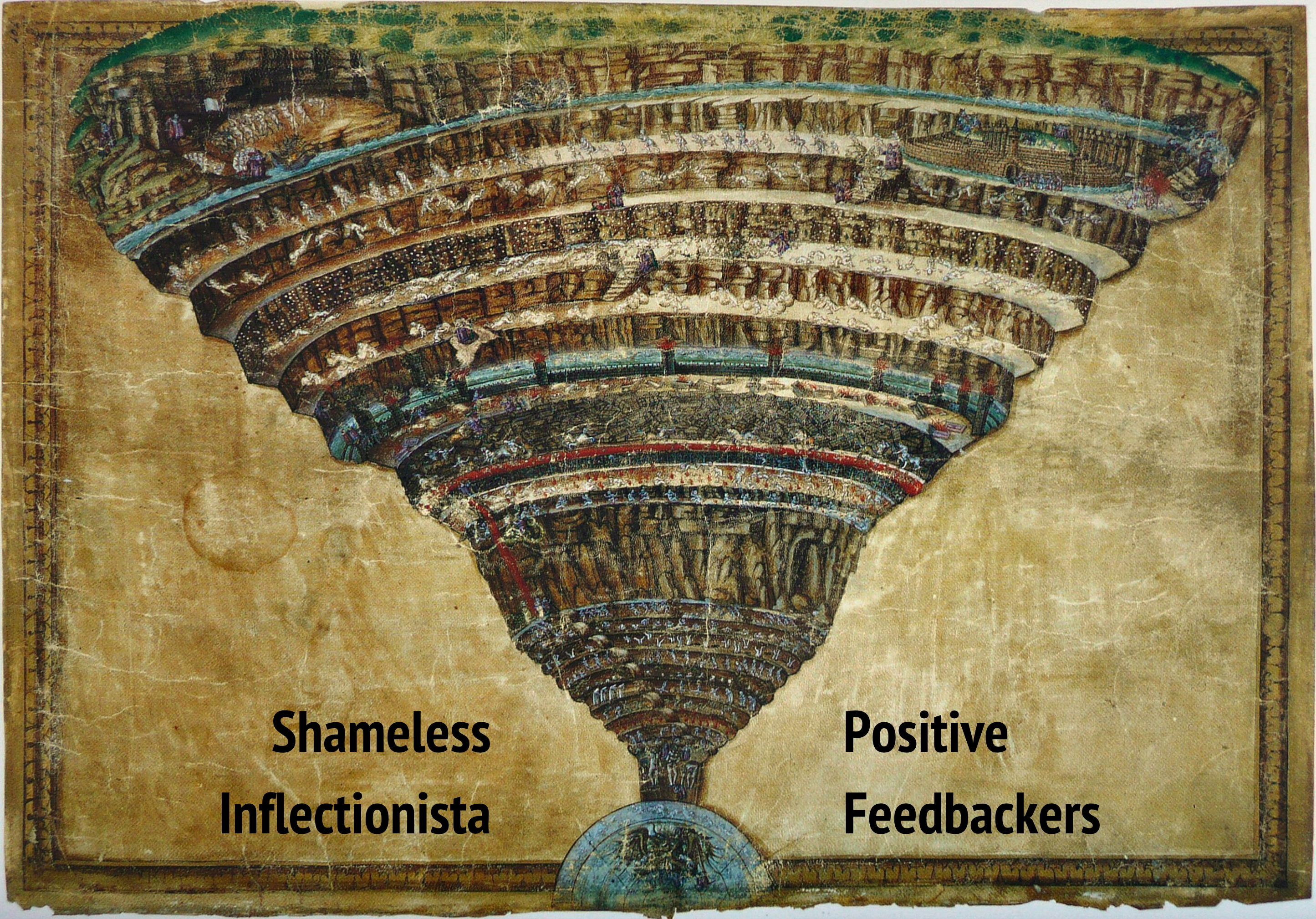
Hell, hath a new level.
The new prize for just “showing up” is a one-way ticket to Dante Level Eleven.
The Opportunity in Deep Learning Theory
To wrap this up, as the first in a series of thematic notes on artificial intelligence, I want to shake a stick at the area which I think is most promising. The investment strategy derives from a hunch on what I think is coming soon.
For now, I will continue on the theme of mathematical innovation.
Just to make it clear where this is coming from, let me say that neither you nor I need a gigawatt of power, from a nearby nuclear power station, to read the newspaper and have a good spray about the latest reported nonsense from our leaders, decide how to cook a meal from what is in the fridge, or watch which stock is going up.
Superficially, we are supposed to believe that human intelligence is obsolete.
However, I can assert, with confidence, that only humans can reliably tell when any of the current crop of AI chatbots is off with the fairies hallucinating.
That is because our minds solved the epistemological problem I framed above.
What we know, as a species, is that pragmatic solutions to this question do arise once we exercise our minds in a vigorous critical inquiry into what we actually know.
They used to call this quality, of accurate self-knowledge, humility.
Like pornography, you cannot properly define it, but you know it when you see it.
Although, philosophers have struggled to “solve” the problem of epistemology we can be confident that it is solvable, for practical purposes, by a working mind.
You have one.
I think I have one.
Therefore, I think this practical question, of understanding deep learning, is solvable.
Notice, that I did not say: “Solve for the meaning of life.”
Nor did I say: “Solve for how to build a master race of bots to rule us.”
Pursue whatever goal floats your boat.
Scientifically, what we have in front of us is a situation that is remarkably similar to that which confronted Norbert Wiener in the tumult of 1940s engineering.
Engineers had hacked together hugely powerful automatic control systems, which they knew could be unstable, but they could not figure out why.
Wiener noticed that, abstracted away a mathematical system of defined and limited scope, linear control systems satisfying the Wiener Quad constraints, about which mathematics could be invented, to properly define and solve the problem.
This approach is what is needed right now with machine learning.
This is not a statement designed to flush money out of witless Venture capitalists.
They are not going to be interested in backing any viable solution to this problem.
Witless Venture Capitalists are the problem, period.
In the history of science and engineering, we have been in this exact spot so many times before that it is not funny. I opened this account with a photo of Maxwell.
What was the critical instability problem of the Age of Steam?
When you ran a steam engine, there was a domain of speed control where the machine would become unstable and shake itself to pieces.
This fact did not dissuade Victorian industrialists from splashing cash on steam engines. However, it did mean that much of that cash went up in smoke.
The entire factory went up in smoke when the steam engine disintegrated.
Everybody now knows that James Watt, invented the centrifugal flyball governor to regulate the steam and speed of a steam engine. That was in 1788.
James Clerk Maxwell explained the mathematical control principle in 1768.
This is history repeating and rhyming in exactly the same way.
Industrialists are raising ever more money to throw at artificial intelligence.
However, they are none of them, including Elon Musk, doing much thinking.
The thinking is happening in arcane corners like the Geometry of Deep Learning.
The central issue is to achieve controllability of machine learning through the constraint of the learning system. Less is more, because you have reliability.
This can be difficult to explain to the non-mathematician.
However, I can give you something to hold on to.
Earlier I commented that positive feedback is unstable because it will naturally take a small fluctuation, like that generated by the butterfly wings in chaos theory, and just magnify that up until it dominates the system.
It is negative feedback that promotes stability and controllability.
The problem with current neural network designs is that they can make very good approximations to any function, but there are no clear stability controls.
Stability for systems of iterated functions is a purely mathematical question.
The problem is one of invention within the field of mathematics.
We do not know the right constraint on the allowed functions.
I can say this with complete confidence, because I am competent as a mathematician.
Needless to say, I pay attention to figuring out a solution to the problem.
I do not need a lot of money to solve this problem.
If I do not do it, somebody else will.
They will not need a billion dollars of funding.
The Prerequisites to Solve Deep Learning
This may seem arrogant, but I am both an investor and a mathematician.
The short list of requirements to solve this problem is not great.
You need one of these.
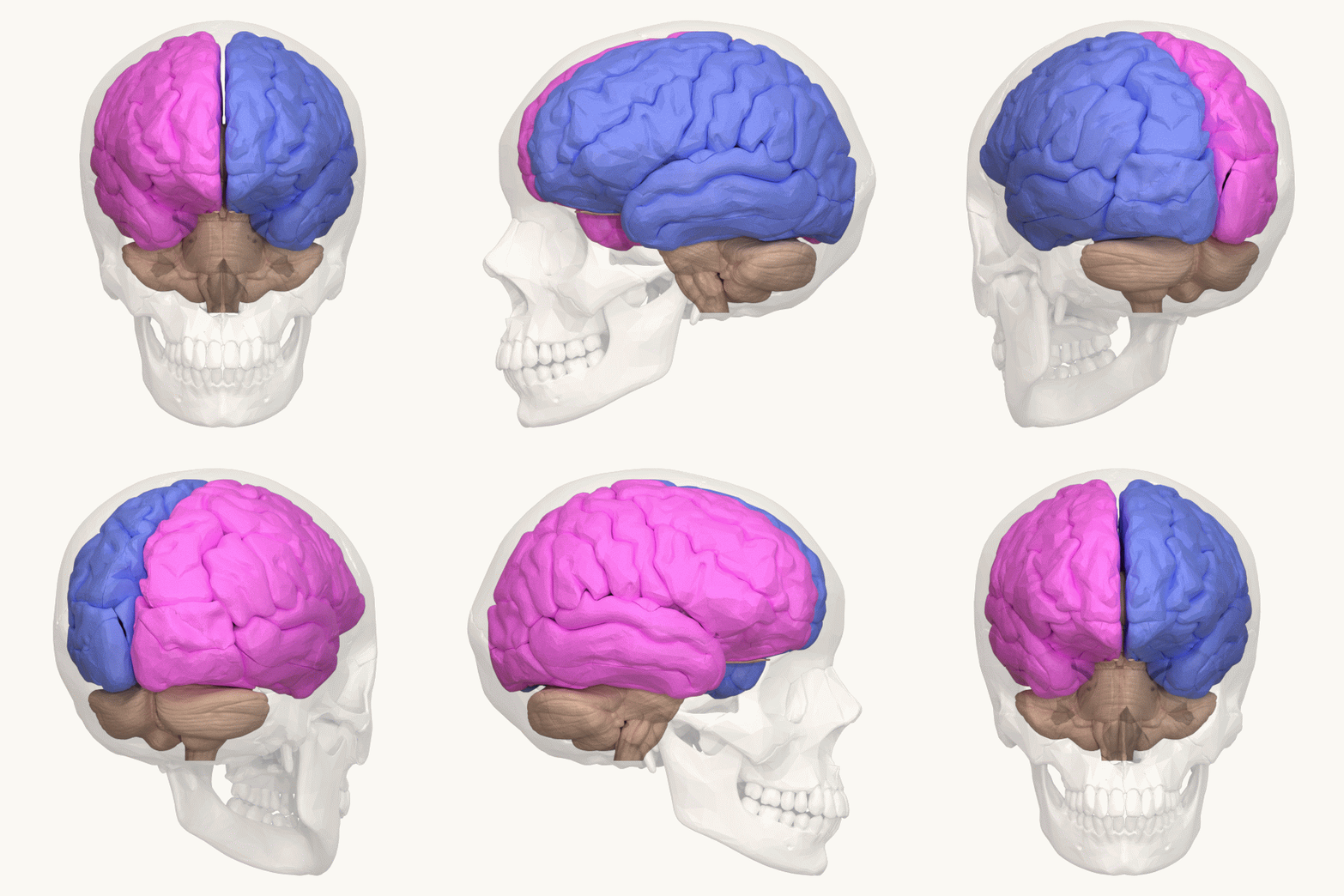
In addition to that, you will need one of these.

Where you write down your ideas is entirely up to you.
I use notepads, walls, bus tickets, quality napkins, book margins, whatever.
It does not matter, because you are defining a class of functions.
The answer will be short and sweet.
Let you know when I find it.