


The present markets are in the later stages of bubble-essence.
There is a looming energy crisis, whose origin is plain to see, but which the markets have chosen to ignore in preference to Elon’s Law of Large Numbers.
The bigger the pro-forma IPO forecast the more likely the stock will float.
What the stock does after it floats is not important. Insiders are out.
This might seem churlish, narrow minded, and short of the Grand Vision Stuff.
Perhaps, but that is not how I see the world right now.
Presently, I am very excited by developments in artificial intelligence, but not for the same reasons as Silicon Valley. I am not very excited by the idea of superintelligence, because I think the human race already has access to this in a simple manner.
Superintelligence is the act of thinking when everybody else refuses to do so.
You do not need to spend a billion dollars to acquire superintelligence.
You just need to use your mind like we all do on a good day.
Rinse and repeat and you are on the right path to a more meaningful existence.
This post is about two ways of thinking: birds versus frogs.
I borrowed this nomenclature from Freeman Dyson, and his collected selected papers.
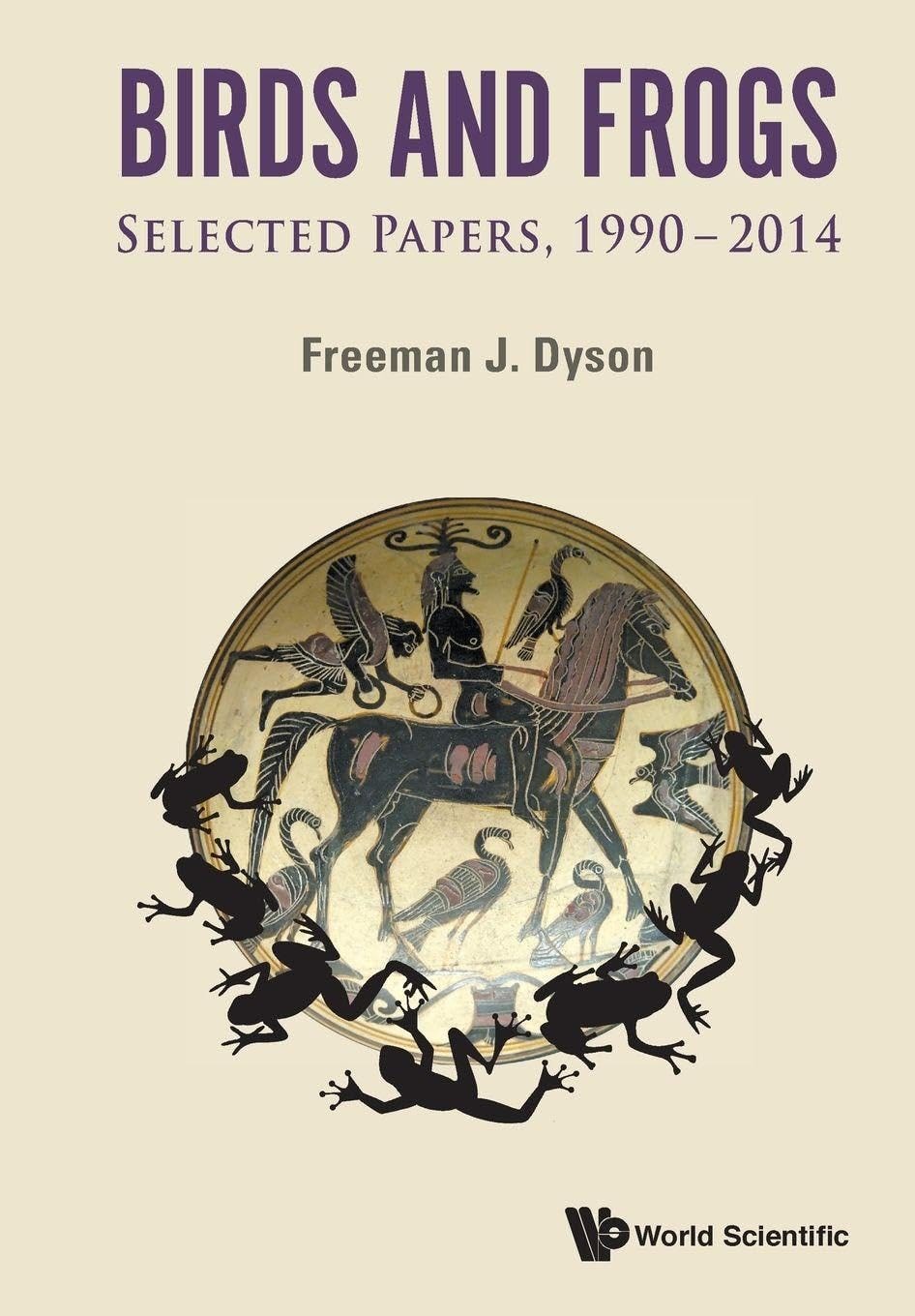
For context, Freeman Dyson was one of four physicists credited with solving the then milestone problem of how to calculate finite results in Quantum Electrodynamics.
This is the famous renormalization problem of QED.
The issue was infinities arising from the inclusion of known, but troublesome, effects like the force an electron feels due to its own field, or that the vacuum, nothing to folks riding the Civic to Tuggeranong bus, feels from everything floating in it.
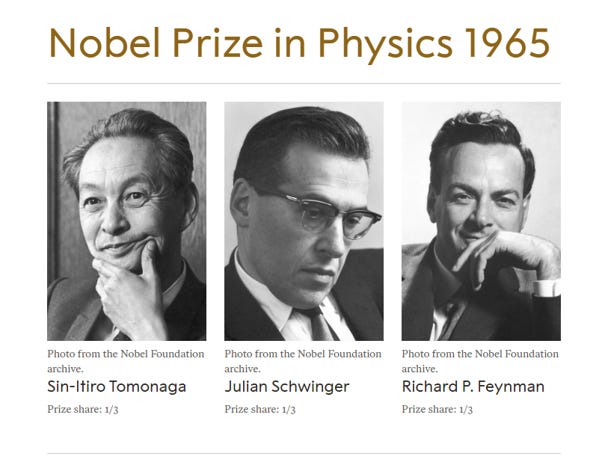
The 1965 Nobel Prize for Physics was awarded to these three individuals for:
“…their fundamental work in quantum electrodynamics, with deep-ploughing consequences for the physics of elementary particles”
The prize was equally assigned, in recognition of contribution, to:
Shin-Itoro Tomonaga, Japan
Julian Schwinger, USA
Richard P. Feynman, USA
which is fair enough. It was a giant step forward.
The reason I mention Freeman J. Dyson, is that he also “did it”, but found a fourth way to “do it”, that unified the other three ways, to show that they were equivalent.
Needless to say, you can only do that when the others have already done their bit, and the Nobel prize can only be shared by three people. Dyson never got one.
I don’t take issue with any of this but am ready to note that Freeman J. Dyson had much to ponder after 1965, and to develop a philosophical approach to life. Giant intellect that he was, he came up with my favorite classification of thinkers:
Some mathematicians are birds, others are frogs. Birds fly high in the air and survey broad vistas of mathematics out to the far horizon. They delight in concepts that unify our thinking and bring together diverse problems from different parts of the landscape. Frogs live in the mud below and see only the flowers that grow nearby. They delight in the details of particular objects, and they solve problems one at a time. I happen to be a frog, but many of my best friends are birds.
- Freeman J. Dyson, Birds and Frogs
I met Freeman Dyson once, at the Princeton Institute of Advanced Study, back in the early 1990s when I was a post-doc in theoretical physics. It was over lunch, and my host Stephen Adler introduced us. It was just pleasantry, but he had a penetrating stare that I could have readily mistaken for that of a raptor like bird.
This frog was a little nervous.
Dyson is describing two different styles of thinking that we all share. There is the down in the weeds, frog world, and the up in the sky, bird world.
I started life as a frog but then learned to fly like a bird.
Now I am both, like most folks in later life.
In simple terms, the difference is analysis versus synthesis.
If you are anything like me, you will have been better at analysis when you were young and have learned to complement that with synthesis as you got older.
It is not that one is better than the other, but synthesis depends on accumulated knowledge and experience, which you have in smaller measure when young.
This is just life and the neuroplasticity of the brain which literally changes and grows as you get older, learn more, and are exposed to more sensory information.
Of course, there comes a point where we all slow down, but in higher functions this is much later than popular wisdom would suggest. I met Dyson when he was seventy and I was thirty. He was sharp as a tack, and well versed in the state of the art.
I left corporate life at the tender age of forty-eight because the intellectual climate of a large Australian financial institution was just so visibly lifeless. Nothing happened.
I contend that the reason why retirement from corporate life just gets earlier and earlier in chronological age is because the corporate IQ has collapsed.
You will find no less stimulating or brain-dead environment than a contemporary corporation. This is echoed in our financial media, which is just barely sentient.
For the record, Dyson, when I met him, was a manifest superintelligence.
Dyson croaked like a frog and stared at and through you like an eagle.
Profoundly impressive!
The Mythology of our Time
This is supposed to be a thematic investment blog, and so I will need to rapidly reverse out of social commentary to introduce market commentary.
In an earlier piece I remarked about the relevance of Hegel to investing.
In the opening lines, I opined:
The markets run on mythology which is the full picture of human narrative.
This perspective may seem odd if you think all investment is based on analysis.
Mythos is like kryptonite to the logical part of our brains.
Myths are fantasies, tales of fictional characters doing impossible things.
How could mythology, and the world of superheroes, relate to practical investment?
Goethe said it best:
“Dream no small dreams for they have no power to move the hearts of men.”
- Johann Wolfgang von Goethe
What will move a late bubble stage market is an impossible dream.
The future is Data Centers in Space.
This could happen, but I am a physicist.
I think the future was already announced by He Tingbao, of Huwaei, on 25-May-2026.
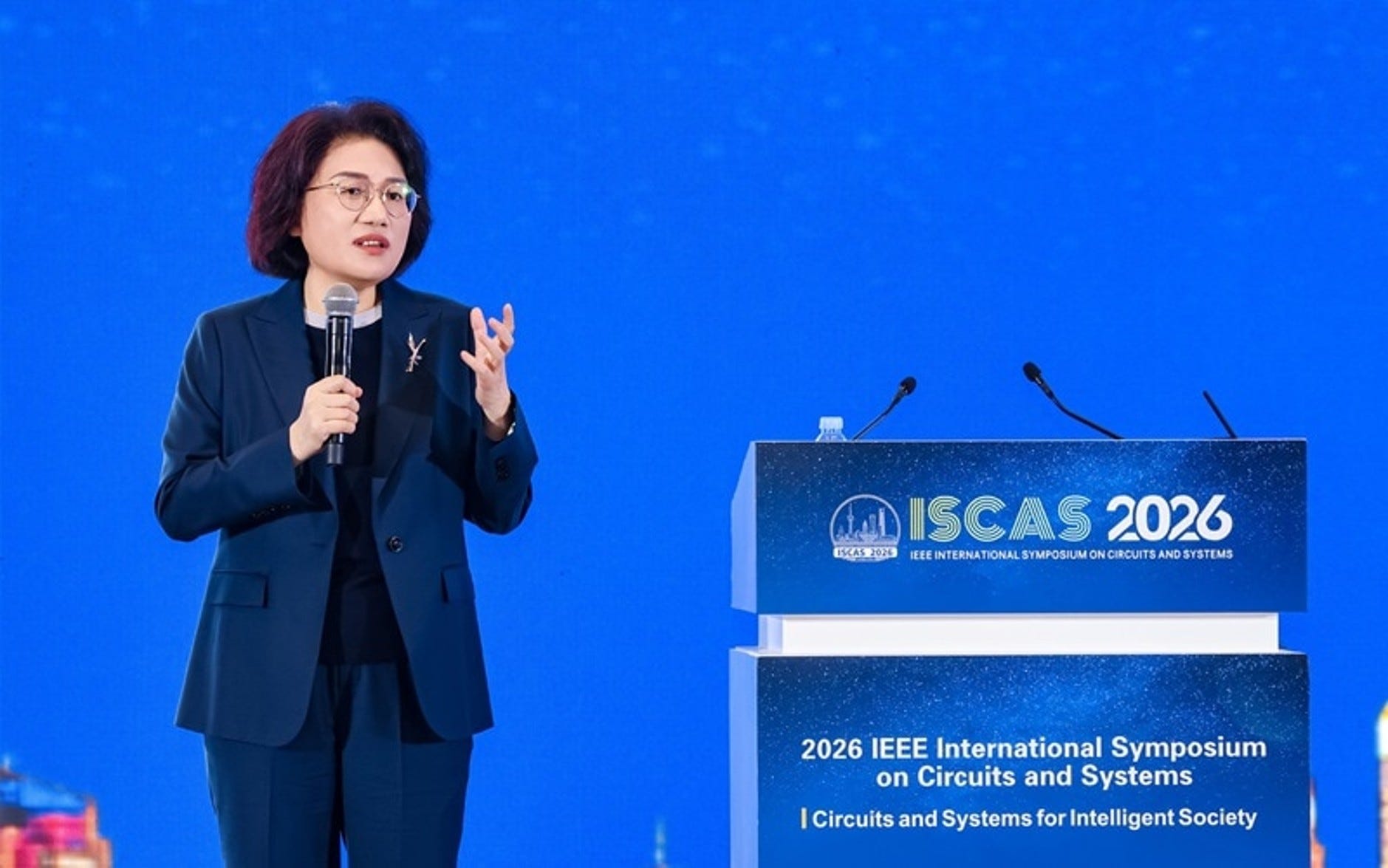
The announcement from He Tingbao, at the 2026 IEEE International Symposium on Circuits and Systems, an international conference on circuit design, flagged their approach to the post-Moore’s Law world of chip design.
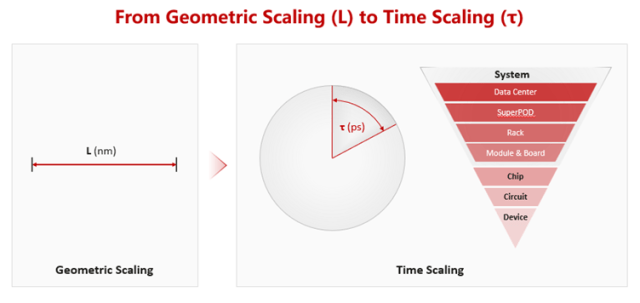
Everybody knows that Moore’s Law concerns the observation that transistor count, the operating components of computer logic, has been doubling every eighteen months since around 1965, when Gordon Moore, pioneer of the integrated circuit at Intel, first put his Rotring to 1mm stock graph paper and drew a straight line on a semi log scale.
The first version of this law died around 2010, with the death of Dennard scaling.
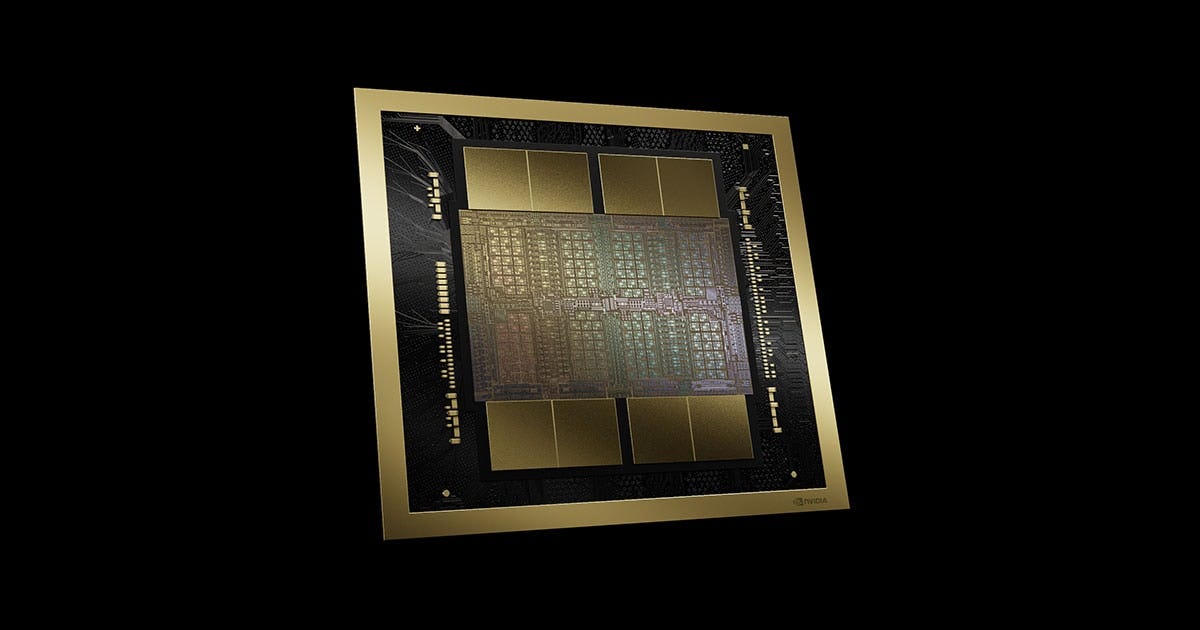
This meant that the clock speed of processors hit a ceiling. Once you went to every smaller feature size, meaning more and smaller transistors, the heat dissipation problem maxed out clock rates. You needed to go to larger dies.
Twenty-five years ago, I wrote my first research piece on data centers.

It was titled “Three Laws for the New Millennium” and covered these:
Moore’s Law
Metcalfe’s Law
Amdahl’s Law
It still stands today, much as I wrote it, even if it had no influence then.
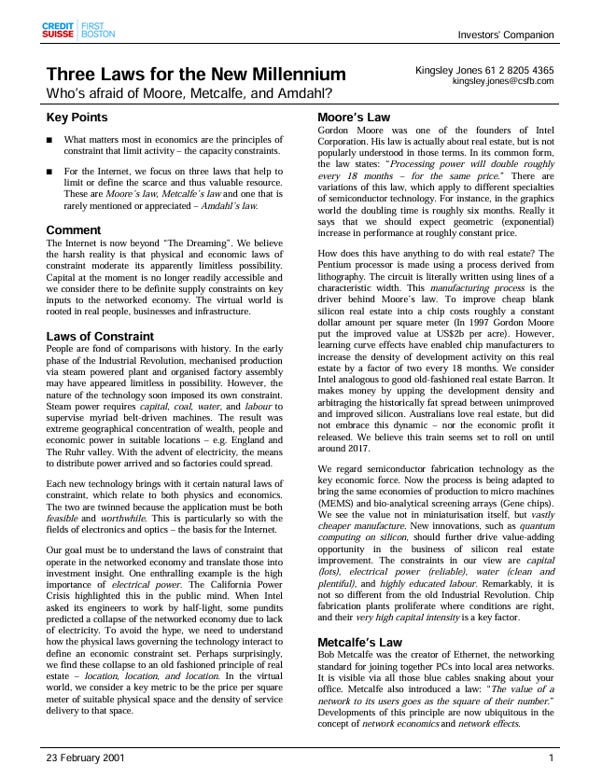
Note that I concluded the research note with this statement:
“The irony of our age is that a large farm of disks and servers happens to use a fair bit of electrical power and has a pretty extreme floor loading and air-conditioning requirement. Some rough numbers are around 500kg per square meter floor loading and upwards of 1kW per square metre power density. In a 1000 square metre data centre, you have 500 tonnes weight in a space filled with 1000 bar radiators going full bore which you have to keep below 30C through air conditioning. You need a friendly utility to deliver 1MW of power and a good fire brigade in case your air conditioning fails and the building melts. We consider this impressive real estate and often hard to find. The keys in our view are location, power density, fibre access, and cooling.” - Kingsley Jones, Feb-2001.
In a nutshell, I was saying this is a real estate problem: location, location, location.
It may have been twenty-five years ago, but I could see why you may want to go to a faraway cold place like space to get the unlimited real estate you might need.
The advantage that foresight gave me is the leisure time to think of creative solutions to this problem that did not involve spending vast amounts of money on power and cooling. The main one I came up with is analog computing. I am happy to see that many engineers are now pursuing that, which has a good investment case.
The other opportunity, which I did not anticipate, but which has now surfaced, is to change the game from 2D to 3D and to stack the chip elements vertically.
This is what Huawei is pursuing in the tau-scaling strategy.
Chinese firms are not the only ones pursuing chip-stacking, but they are leading in the space due to the pressure of American chip sanctions. The road to finer features out to the currently planned 1.4 nanometer node is blocked to them.
They have no choice but to go up, and not out.
The tau-scaling thematic will provide disruptive investment opportunities.
Let us bring the thematic focus to a sharp conclusion:
There are many current market myths that will not survive the next decade.
These are too many to count, but I will list the main ones:
Analysis beats synthesis: the big picture does not matter.
Innovation is a scarce resource and a capability controlled by the few.
Old dogs cannot learn new tricks even when their life depends on it.
The last will be most engaging for many of my readers.
Let us see how AI has disrupted ageism.
The Matter with Things
One of the more interesting features of my personal journey through the past six decades has been the progressive narrowing of the Western perspective.
The West used to be a place that was brimful of self-confidence, that it was the best, and that would stay that way, because, because, because; I rest my case.
I had the good fortune to have gone around the World and visited many places, in most continents, before I was six years old. I never believed the advertising.
The World is a big place, and a profoundly interesting place.
Human civilization is a vast interwoven tapestry of influence and counterinfluence.
I do not subscribe to any of the modern warring tribes of Western discourse.
I am not Left nor Right.
I am not Globalist nor Nationalist.
I am not Logical nor Analogical
I am not Detail oriented nor Gestalt smoke.
In short, I am not perma-polarized and consider myself adaptive to circumstance.
I am both frog and bird.
I think many people are, if not all people, but our social conditioning is powerful.
The corporation is a dead place because it demands that we be frog or bird.
You have to fit the pigeonhole, and it just keeps getting narrower and narrower.
This is a disease of the collective Western mind.
This is not a disease of any individual mind; but the collective mind is sick.
Nobody likes to be pigeonholed but take a look at the press headlines!
Let me say this, I am not negative on the future, because I see this as a time ripe for a massive software upgrade of the collective intelligence. The vector for this cure, will also be the main vector for the social cataclysm of absorbing the change.
That vector is artificial intelligence.
The reason for this is rather simple and will be apparent to anybody that has spent a long time doing analytical tasks. There is much down in the weeds work for those who analyze things for a living; fact finding; argument testing; consensus framing.
What separates great analysts from the mediocre is the quality of the questions they ask in pursuit of a particular answer.
The advent of the LLM chatbot delivers ready answers to any question.
The questions you ask determine the quality of the answer.
Analysis moves from the general to the particular.
What separates great synthesists from the mediocre is the mystery of what question they asked themselves to arrive at their unifying answer.
Synthesis moves from the particular to the general.
Notice that each depends on the question.
If anybody on the planet is to profitably use an LLM chatbot they need to have the capability to ask it a pertinent question germane to their field of interest.
This is open territory, both culturally, and by stage of life.
I have zero doubt, that contemporary corporations will soon mint reasons why only a certain favored few have the “skills” to ask the right question. Anybody who reached middle life already knows that a corporation is the very last corner of this planet in which you are likely to find intelligent life that is brimful of pertinent questions.
Corporations are the walking brain-dead of the intelligence gene pool.
What permits the possibility of success in a corporation is conformity.
Proclivity for conformity is inversely proportional to life experience and intelligence. The conventional wisdom is invariably stupid.
No matter what the “vision statement” thinking is verboten because the mere act of asking a pertinent question of leadership promotes the distinct possibility those chosen to lead us have not got a clue what is happening.

Since I am a thinker, who spends a lot of time inside my own head, when I could be out doing something important, like fishing, I am looking out for guidance.
Last year my psychologist brother-in-law, who is married to my psychologist sister, and whose household is never visited without at least two diagnoses, introduced me to the writings of Iain McGilchrist, and his discursive tome The Matter with Things.
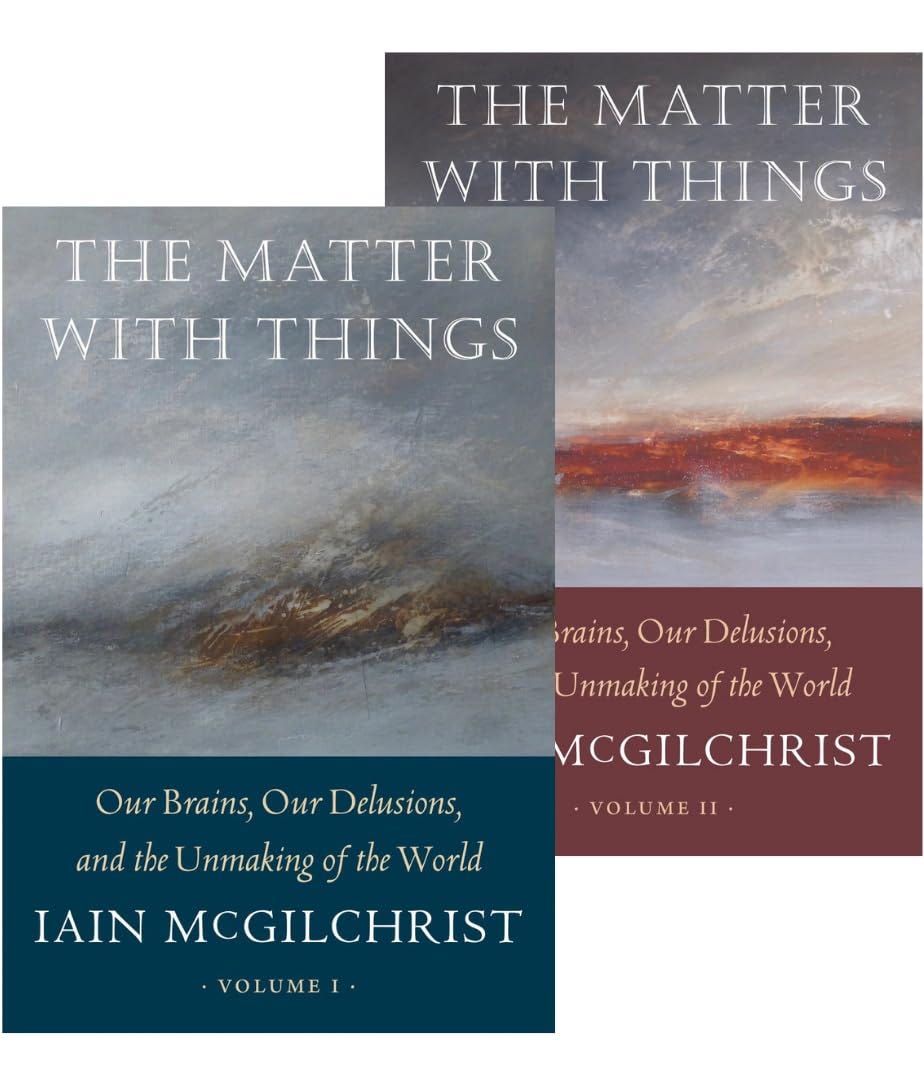
This book has no peer in terms of the depth or controversy of thesis. It can be viewed as a simplistic inquiry into the differences of hemispheric brain function. I could offer some views on that, based on my own experiences of possessing a brain. However, I will not bore you with that, since you have one too, and I do not write as well.
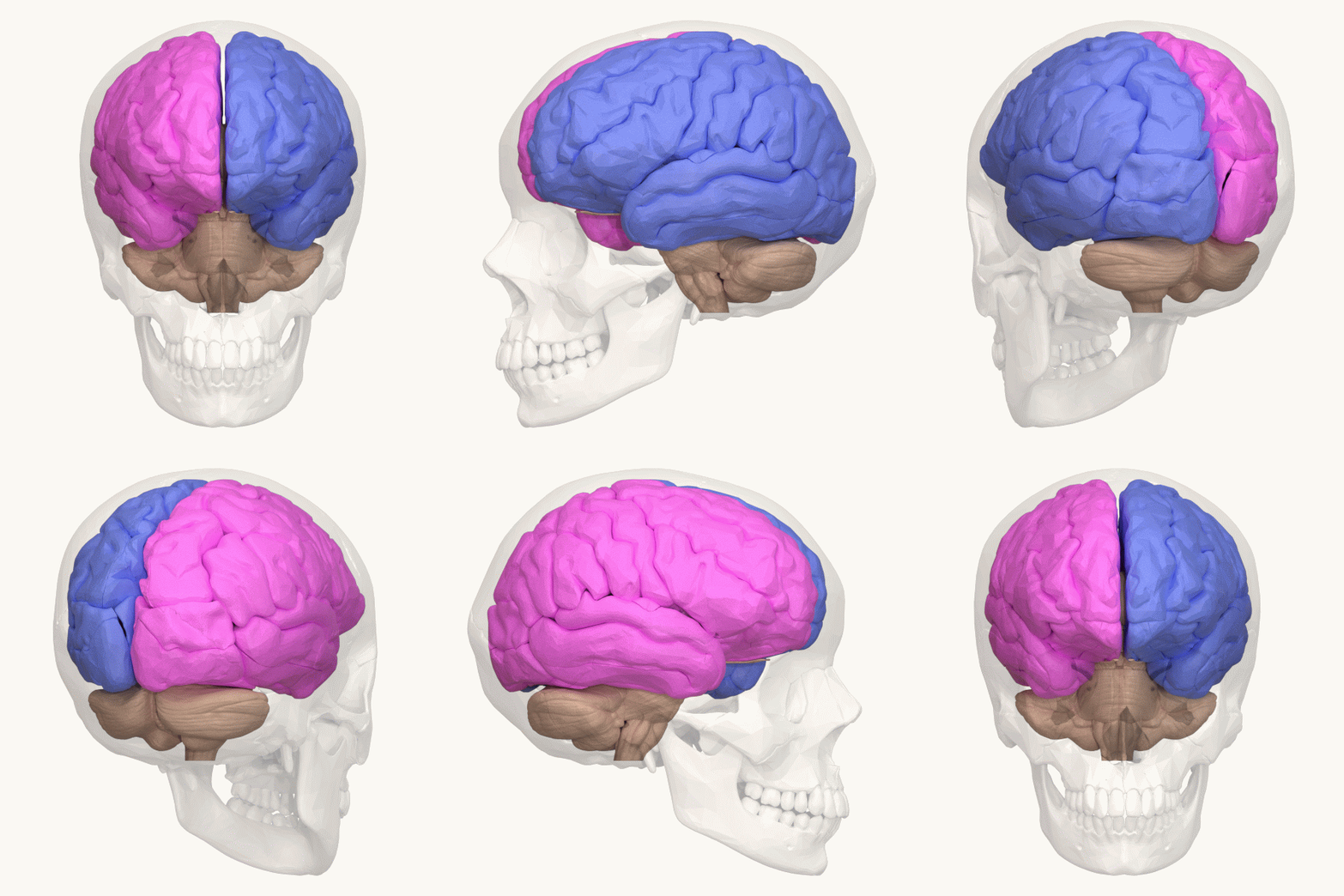
I want to state at the outset, and true to my frog-bird nature, I do not favor the view that one mode of thinking, detail-oriented-frog or big-picture-gestalt-bird, is the best or only way to think about important matters. They are equally important.
However, where I concur with the thesis of McGilchrist is that our social collective intelligence is lurching dangerously into a one-sided half-brained world view.
I will let you form your own opinion.
For what it is worth, you know mine.
The Renaissance Opportunity
It is always darkest before dawn, and we each have our own comforting talisman to cling to in times of strife. I am an old enough to have seen several social upheavals, and so am unworried that a new one is clearly approaching at high velocity.
Like anybody, I have experimented a lot with chatbots.
They are smart, up to a point, but clearly lack discernment. I would mark the bots as you would any precocious student of great potential.
F+ with “F” for Frog, and a + for trying to fly like a Bird!
The problem is not breadth of knowledge, nor even depth of reasoning, or speed of recall, which is frightening. The problem is one of pure gestalt, the Bird bit.
There is intelligence present but there is no where there.
Where would you like to go next? I don’t know. I am not conscious, says the bot.
This is a tremendous opportunity for the bird-brained amongst us.
The secret of discovery is to ask the right question.
The LLM chat bots of our era are trained on the most arcane fields of knowledge that their Silicon Valley masters hoovered up into the machine, without paying for it.
These machines are now provided for free.
There are occasions when I might pay for a chat-bot, but I have not yet. The path that my firm is taking is to use Retrieval Augmented Generation (RAG). I will write about this at length, but for now you can think of it as a way to build research muscle.
In approaching any task of problem solving, it is essential to separate the power of reason from the corpus of facts over which to apply such reason. The human mind does not need to remember everything to solve any given problem.
Intelligence is the power to recognize what you don’t know that is pertinent.
It can be hard to communicate this clearly in a world obsessed with credentialism as the qualifier of authority. However, that is a purely social construct. What matters to the trajectory of human knowledge and understanding is imagination.
Imagination is more important than knowledge. - Albert Einstein
The solution to problem solving is not more knowledge, but more imagination in how we should apply presently known facts, to uncover what we don’t know.
The manifestation of an active imagination is to pose a new question.
I maintain that every creative act of the human mind consisted of a new question. You ask yourself: “Why this, and not that?”. It does not matter if you a jazz musician, and seek a new way to skew time, or you are a quantum physicist in ten dimensions.
All human progress began with a new question.
The problem of our time is too many certainties and too few doubts.
Doubt is not mental weakness, but the path to new truths.
This is true in any endeavor.
You cannot forge new solutions repeating past mistakes.
I believe this so strongly, that I restructured my own corporate enterprise.
We are now an institute in name only, but we have a mission.
Jevons Global is committed to use artificial intelligence in service of synthesis.
I have already had such deep and rapid progress in so many research fields of interest to me that I think it is time to share that learning.
The opportunity now upon us is to apply artificial intelligence.
I do not mean to own it, like some captive gimp in the Silicon Valley basement.
I will leave the fantasies of complete and total world domination to the plutocrats.
They never impressed me, and I think I can run intellectual rings about them, when hobbled with ankle chains, running a sack race, on Mogadon, wearing a blindfold.
This is NOT an impressive slice of humanity.
No, the prize on offer is an efflorescence of scientific and cultural progress.
That is something we can all participate in.
More later…
Retrieval Augmented Generation (RAG) is both transformative and fun!
I used Ai to apprehend the gist. The laws of constraint are still in play. And even though I cannot foresee each and every law and bottleneck as well as you do it helps to know how feasible space data centers is in the near term...
From Gemini: *The author would likely conclude that mass-scale commercial data centers in space are economically unfeasible. While a "Bird" can imagine a beautiful, borderless orbital cloud, the "Frog's" unyielding laws of physics and economics—specifically the brutal realities of cooling constraints, lack of direct fibre access, and severe I/O bottlenecks—prove that keeping data centers on the ground, plugged straight into Internet Exchanges, remains the only truly worthwhile play. *