


Monday last week we published a note on relative value trading in gold miners versus gold off the back of the pullback in both gold and the stocks.
This note was titled Gold in the Hand versus Gold in the Ground.
The principles I outlined there are commonly used in the Hedge Fund world.
Many moons ago, I used to write broker research on these so-called pair trades.

The above note on Coles Group versus Woolworths is twenty-five years old now.
The method of pair trading comes and goes because you need the right kind of markets to have it work well. Ideally, these are ranging not trending markets.
Trending markets tend to produce one-way bets.
Ranging markets tend to produce back-and-forth motion.
You could still have a trend overlayed with relative cycles, and I will show how to do the statistical analysis for that in a later note. The key thing to note is that a growth stock market is generally dominated by trends. Value stock markets are opposite.
You can tell by my resurrection of twenty-five-year-old methods that I am retooling for the possibility of a different kind of market, one I am also at home in.
The particular kind of trade I want to revisit today is called impulse reversion.
In the original stock price chart of Northern Star XASX: NST it looked like this.
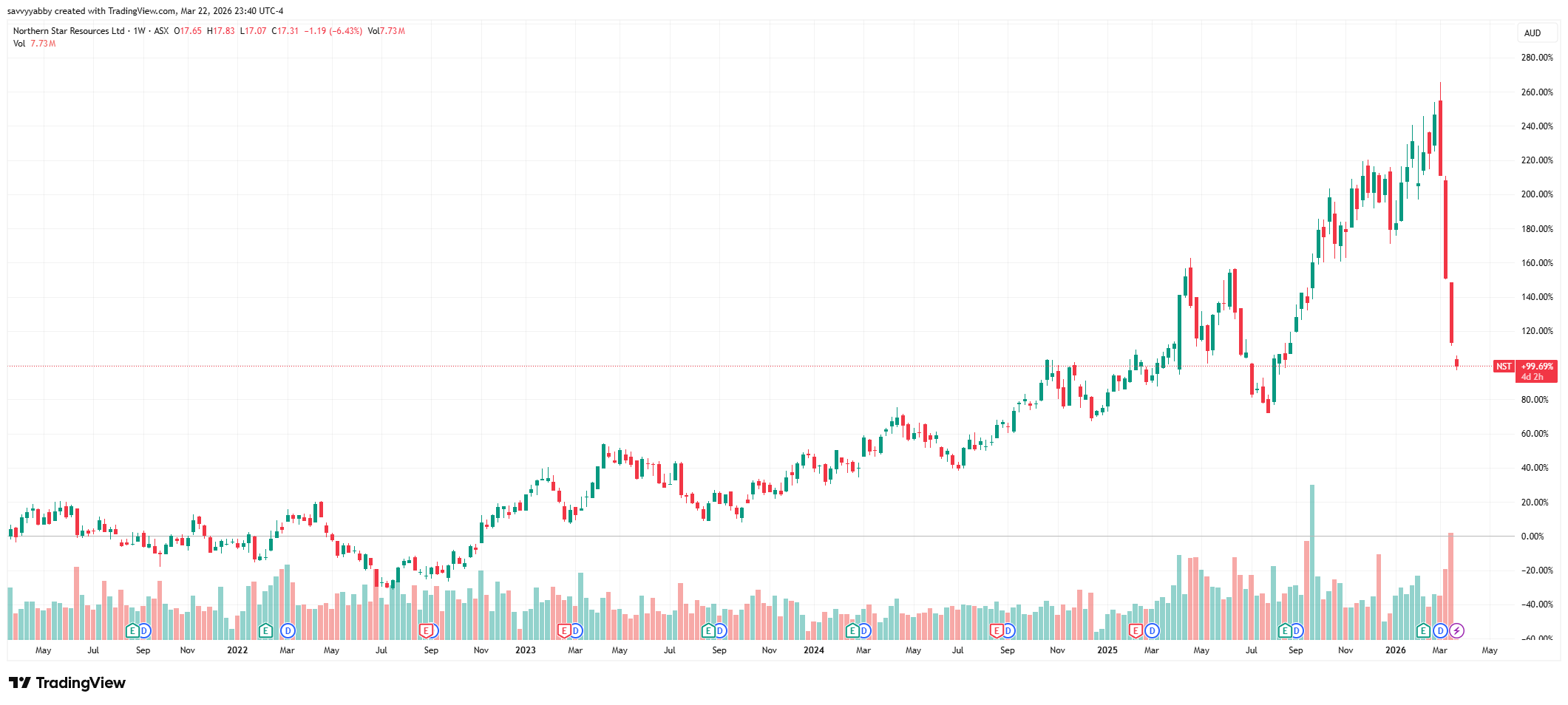
When there are few value investors around the moves can be huge, as you can see above when Northern Star announced a second delay on the KCMG mine expansion. Delays in production cost some short-term excess expenditures to fix and shift the Net Present Value (NPV) further out in the future, leading to a lesser value.
If you were in a hedge fund trading pod, you might well have a model ready to go on stressing the valuation impact to find a warranted price level for entering the trade.
Good value investors have a few rules of thumb on discounting they can do in their head. In the old days of floor trading, this was an essential skill.
Since we have been in a growth market for some decades the skill has atrophied.
That is why you got a 45% down move in a weak gold market. Evolution XASX: EVN was down about 33% over the same period. The value impact of delay circa 5%. In this case, you could look at NST on a relative to see pricing in gold.
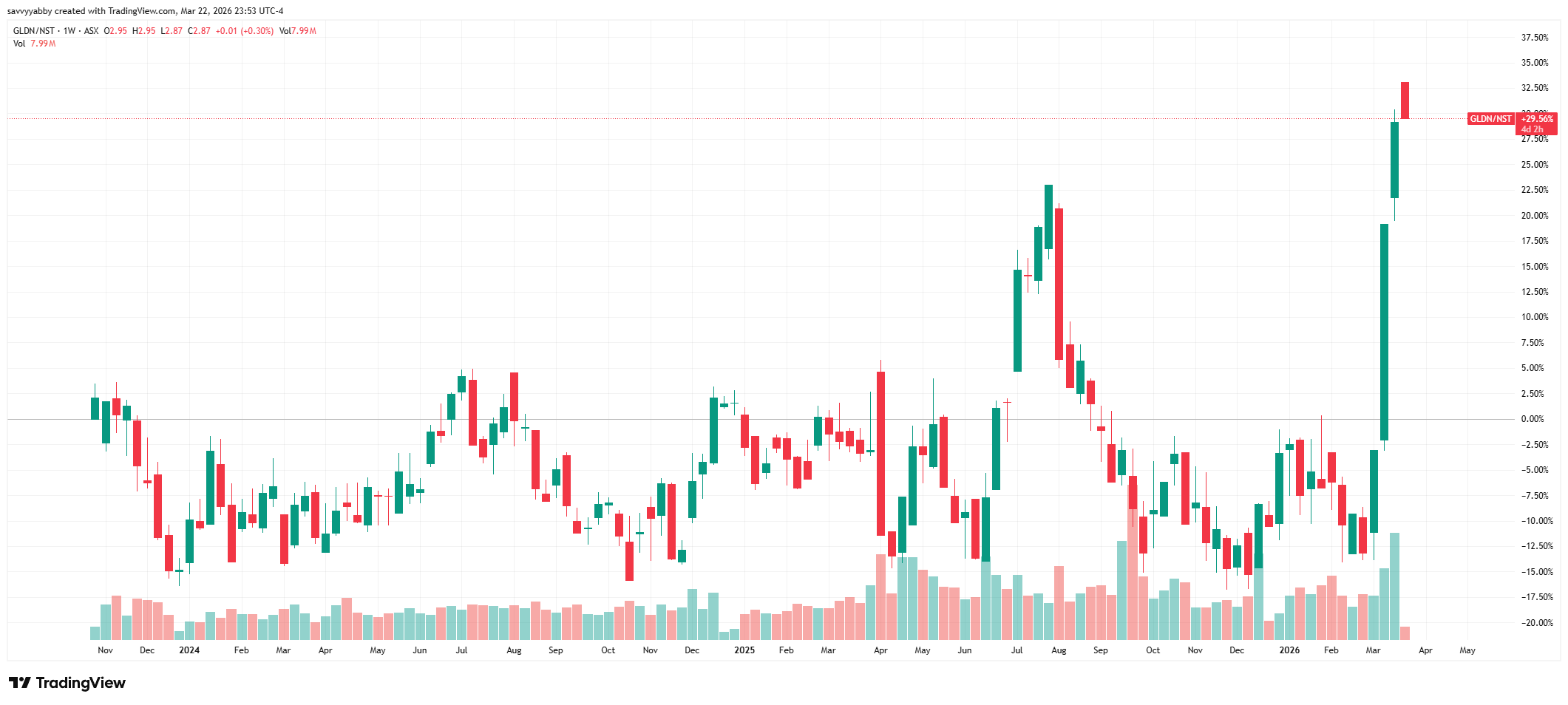
You can see on 23-Mar-26 the relative purchasing power of gold, the product, for the gold mine had soared by about 30%. The trade is then to sell GLDN, the gold ETF and buy the stock, NST. This is why I generally own some precious metal and some stock.
Think of the gold as like cash, which substitutes for the output of the mine.
The purchasing power of gold in the hand for gold in the ground, using the ratio of price of one to the other is a simple test of relative value. This works in a trading pod because you have risk capital to tap, and target rates of return to make.
Obviously, the trade is not worth doing if the stock does not appreciate. Therefore, you only do things this way in a rising Bull market. We have that for both gold and gold miners, so it is a fair bet to do the trade. We can expect impulse reversion.
Let us see what happened to NST after 23-Mar-2026.
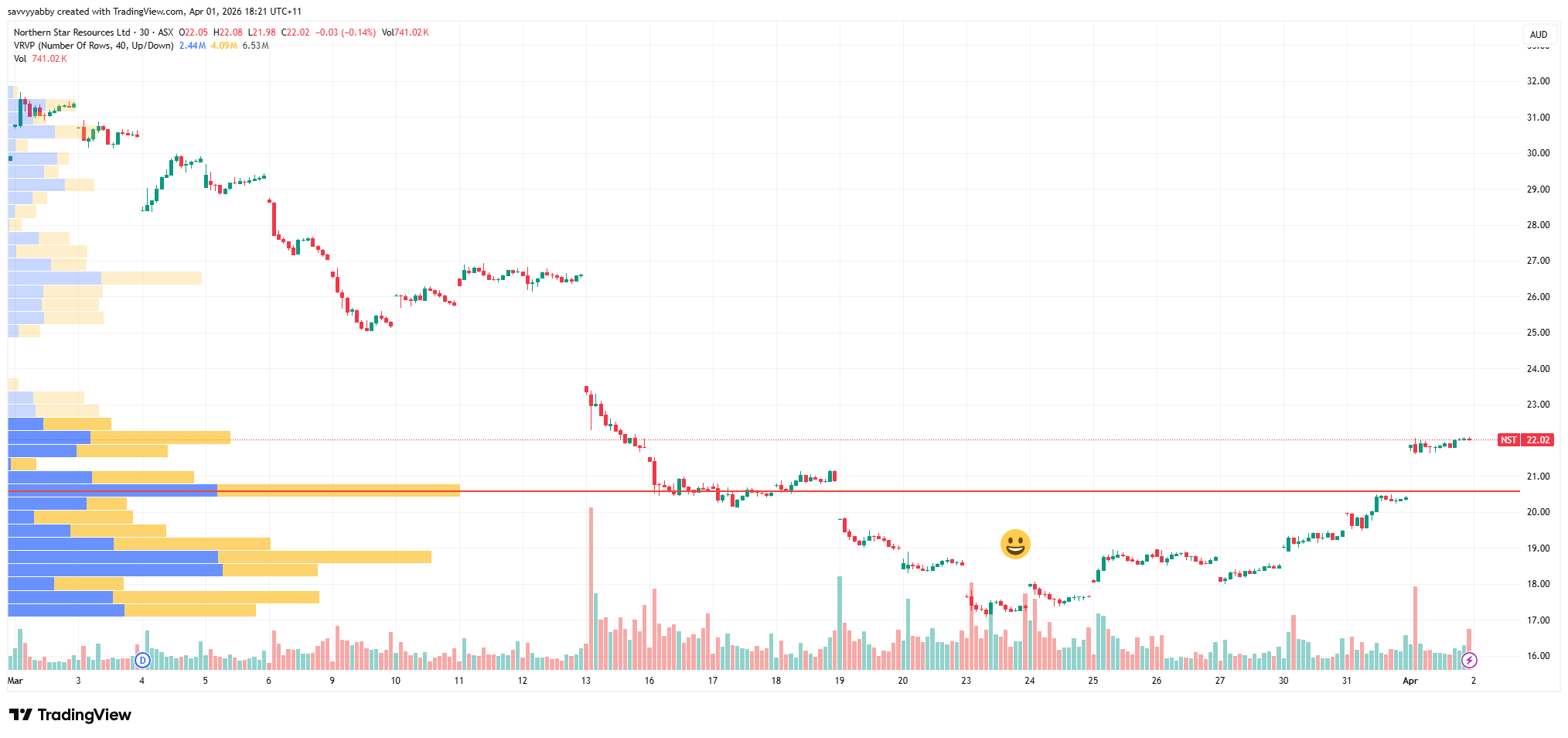
It turns out it bottomed on that day and is up about 28% since to close 1-Apr-2026.
I did not do my trade until 30-Mar-2026, for a lesser gain of 13%. This is for several reasons; the main one has to do with managing risk. When it is your money at risk caution on the turn is advisable. We can see that turn on the relative chart below.
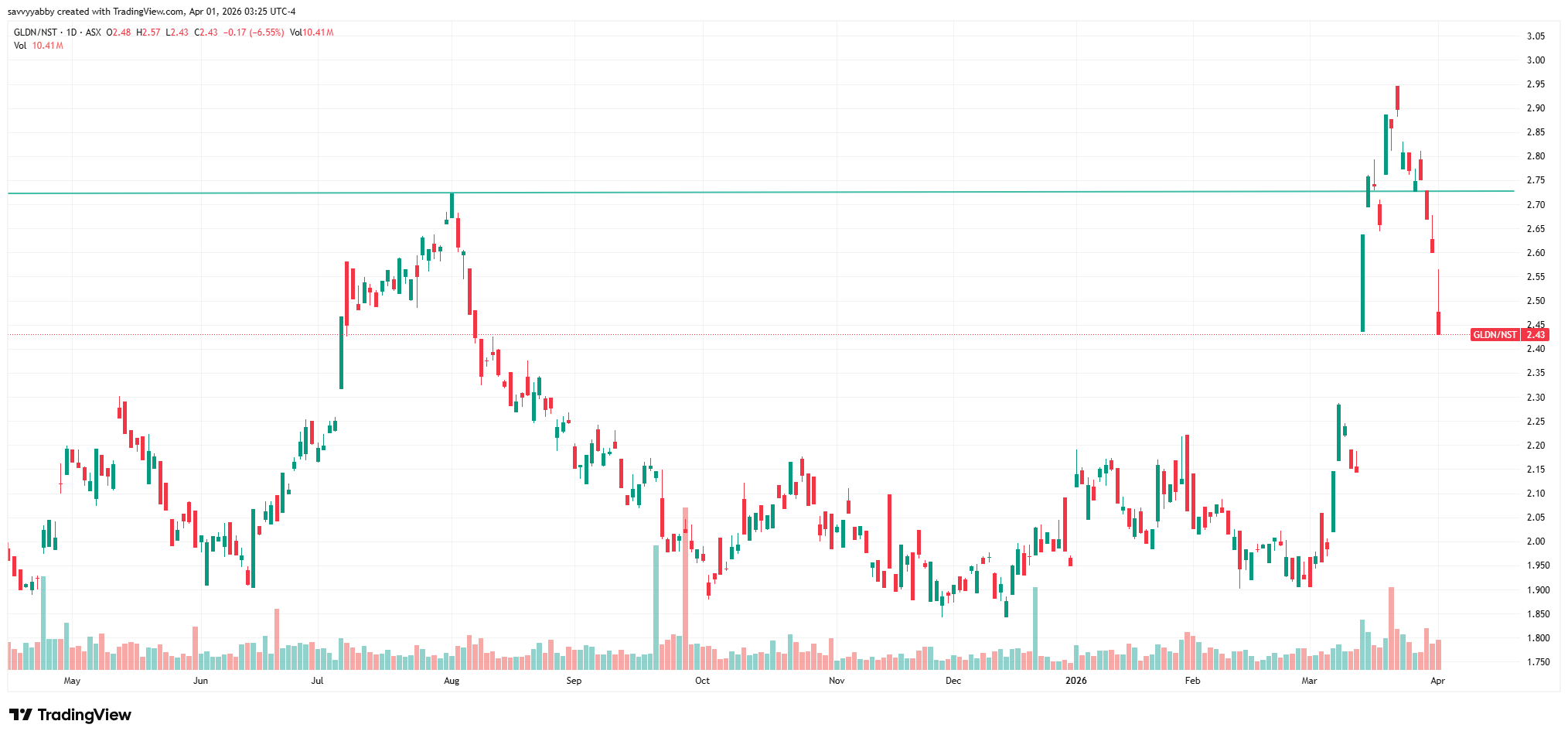
I did my trade when the relative price ratio clearly looked to be moving back and had crossed back through the level of the prior peak. This is a desk trader kludge.
There is no hard and fast rule for where this should go.
You lean into it when it feels right and cut it if it does not act right. Presently, this one is acting right, and we would anticipate a return to the former level.
Note carefully that the “return to the former level” is a rule of thumb judgement that reflects some mental arithmetic on how much the gold miners’ profits are affected by a given change in gold, and or oil prices. In a real pod setting, you would have done the sensitivity modelling, the AISC cost/margin model, and peer valuation.
This is just an educational note as I think we will see plenty of these opportunities.
Twenty-five years ago, when I first learned this method there were proprietary traders on every major investment bank floor, and fund shops full of value investors.
The proprietary traders are gone.
The value shops are dead.
The quant models today are all artificial intelligence black boxes.
If you know what you are doing, this is a good method.
Have fun!