


The Savvy Yabby Report distributes our institutional grade model portfolios to paying subscribers on a monthly basis. The current list includes these strategies.
Australian 20 Stock Model Portfolio
USA 20 Stock Model Portfolio
International (non-USA) 20 Stock Model Portfolio
Global Best Ideas 25 Stock Model Portfolio
The existing research notes and newsletter offer remains, but you will see some tighter integration between what we write there and the model portfolios.
The licensing and complaints procedure is outlined in our Financial Services Guide.

These portfolios follow the Jevons Global investment process.
1.19MB ∙ PDF file
The last change to the model portfolio was effective at close 3-Mar-2026.
The changes were to shed Cochlear COH.AX and Iluka Resources ILU.AX and to add new positions in Rio Tinto Ltd RIO.AX and Woodside Energy WDS.AX.
In a nutshell, we chose to add LNG exposure in the immediate aftermath of the Israel and US action to attack Iran. This decision has been validated by events.
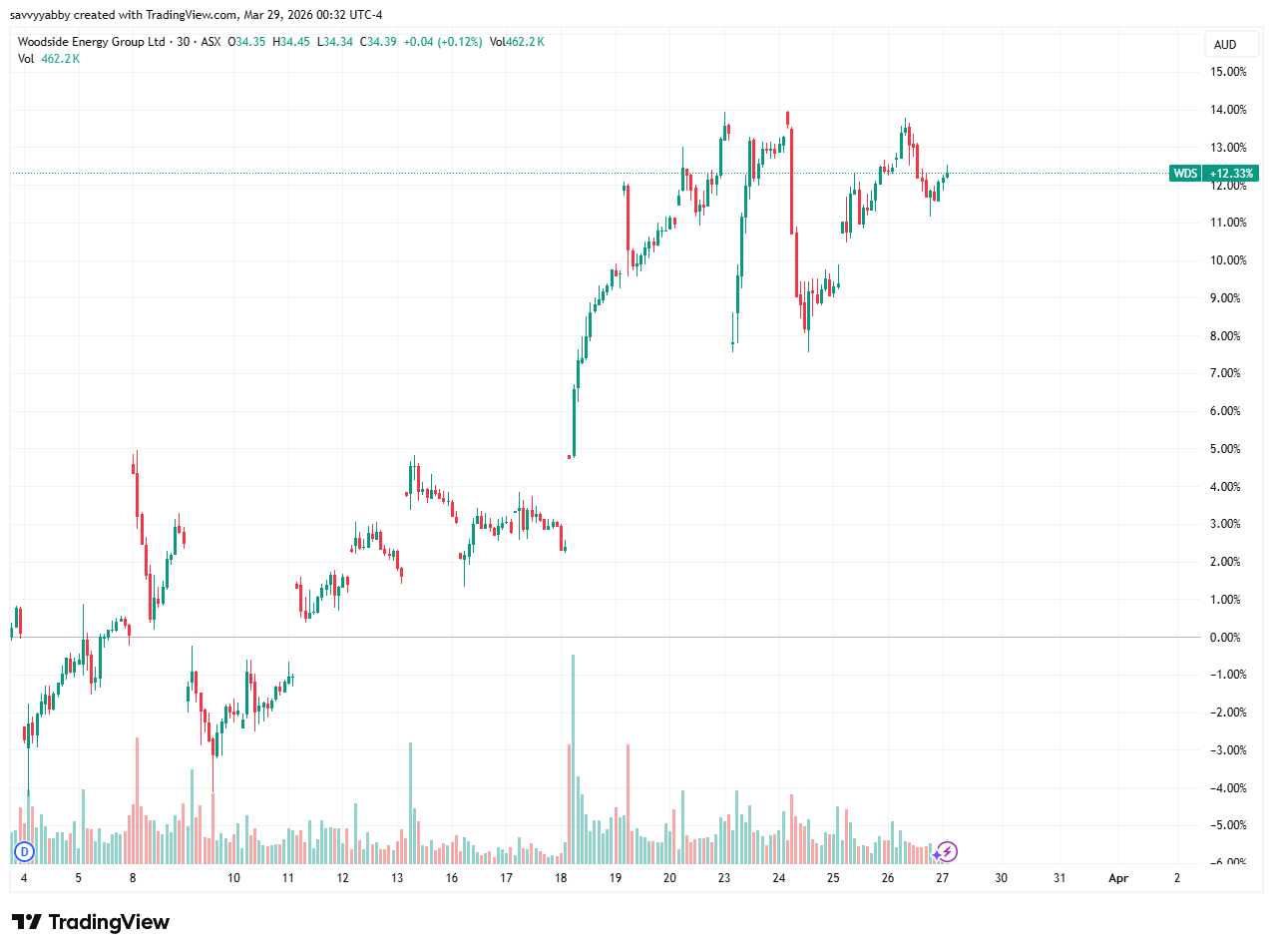
The changes to come this month, effective 31-Mar-2026, are again limited to tactical moves to upweight dividend yield exposure for a higher interest rate market, and to take advantage of swings in the market since the start of the war on Iran.
I do not expect a quick end to this war as the Strait of Hormuz is being used by the Iranians as a geopolitical bargaining chip. The effective closure of that waterway to ships that do not accept the Iranian terms of passage has no foreseeable military solution. This is a rocky coastline overlooked by high mountain ranges.
There are few places to land an attacking force.
The military solution to this problem looks vexed to us.
The above Times Radio interview with Lt. Col. Daniel Davis, a 1991 combat veteran of the first Gulf War, Operation Desert Storm, mentions the difficulty of unblocking the Strait of Hormuz by military means. For comparison, the troops committed to Desert Storm were fifty times greater in number than the troops now enroute to the gulf.
We cannot know how this conflict ends, or on what terms.
What we can anticipate is upward pressure on interest rates, rising prices, weaker consumer confidence, and the increasing risk of credit and liquidity events.
Our Australian portfolio positioning already has a bias to commodities and real assets and is lighter on long-duration growth equities that are negatively impacted by the uplift in bond yields now playing out in markets.
This process has discounted some positions we have in real estate, but the yields and inflation hedging properties of those have been neglected. The primary unpriced risk we see in the larger sectors of the Australian market lies in the banks.
We are already underweight in the financial sector but are further reducing exposure to those parts of finance which generally do poorly in a liquidity crunch.
The bad debt cycle in Australia is contained, but there is risk to funds management businesses, like Macquarie Group MQG.AX, and high-priced banks with low yields compared to history, and to a ten-year Australian bond yield nudging 5%.
In our judgement, the market has further to correct. Without making radical changes, and recognizing that we run fully invested portfolios, we are selectively moving our capital in the direction of value, with yield support, regulated cashflows, or a clear structural deficit on the supply side. This is energy and energy infrastructure, the provision of new and affordable housing, and sustainable capex themes.
There is a case to be made for growth franchises, which have corrected in the past year, but we still see too much valuation risk from a global reappraisal of the very protracted trend to pay higher multiples for software businesses.
In the age of Artificial Intelligence, we see disruption risk to established businesses and prefer to allocate capital into lower multiple businesses which can use debt on the balance sheet to improve return on equity and enjoy pricing power.
We do not yet know which class of business will be best rewarded by whatever falls out of this tumultuous economic adjustment but are prepared to be guided by the reality of cash returned through dividends, and some pricing power.
This is unlikely to be the same kind of pricing power we saw in high gross margin software businesses that grew rapidly in the recent enthusiasm for innovation.
The new market enthusiasms are unknown but likely to center on must haves.
Food, fuel, shelter, security and pipes, poles, and wires.
Supply shocks of the kind we are now facing in the energy, chemicals, food, fuel and fertilizer market, have a habit of upending the apple cart by reminding investors of necessary capital expenditures versus experimental innovation expenditures.
This is not the first time this has happened, and older readers may well remember the huge societal behavior change induced by the 1970s energy crises.
The Global Power and Energy Transition is now upon us and about to get serious.
This does not have to mean radical change all at once.
However, it does mean we need to be alert to how the world changes when money and energy rise in price at the same time. The effects may shock some people.
This is not the world of free stuff that made the growth of digital services fun.
It is quite the opposite of that, which creates its own force for change.
The updates for close-of-trade 31-Mar-2026 are below the paywall.
Macroeconomic Context
There is a visible cycle, which is not regular, like clockwork, but which does repeat over time in relation to commodity prices and interest rates. In simple terms, commodities have a tendency to rise in price when interest rates rise. This is not simple relationship, because the supply of money is not fixed, nor is that of commodities.
However, the relative price of financial claims, like stocks and bonds, is susceptible to a relative change in value versus a basket of commodities. In the 1970s, when price levels for oil and gold soared, so did the cost of living, and financial claims became less valuable in relative terms. The reasons are unknown, but the topic has attracted leading economic thinkers like John Maynard Keynes. Cycles have been observed in the relationship between commodities and rates of interest back to the 1800s.
One version which is easy to display is the S&P 500 Index, normally a price level in dollars, remeasured in the value of gold as $/oz. This index is in ounces of gold.
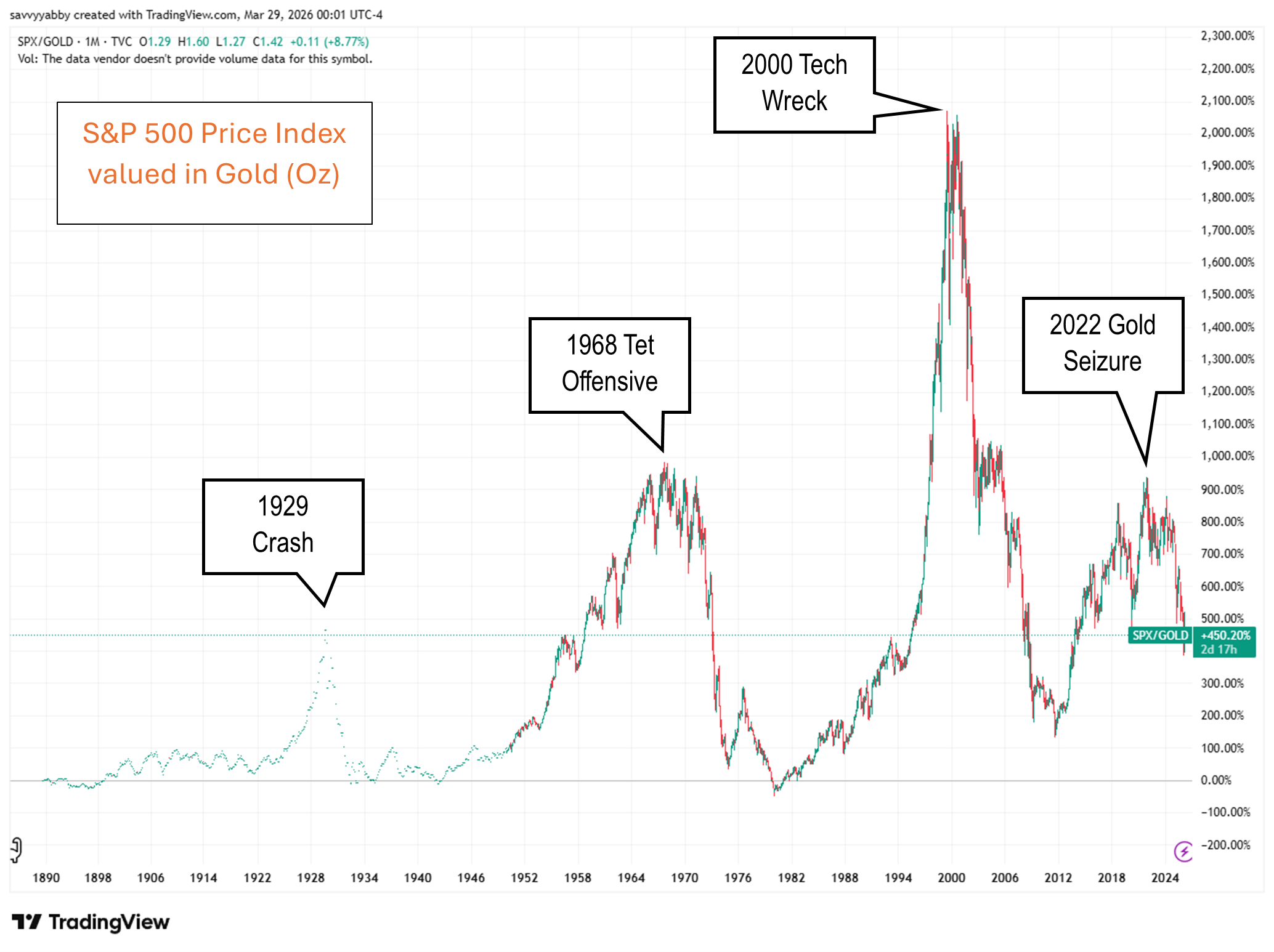
Times of rising prices for money, as indicated by rising interest rates, are often associated with falling relative purchasing power of stocks for commodities.
The labelling on the above chart is coincidental with historical events. Note that the 1929 Crash and the 2000 Tech Wreck marked a period of widespread speculation in stocks. In contrast, the 1968 Tet Offensive, during the Vietnam War, and the 2022 seizure of Russian central bank gold, marked periods when interest rates started marching upwards from a period of relative historical stability.
The 1970s inflation really started in the late 1960s with the Guns and Butter agenda of President Lyndon B. Johnson, the Great Society Program, and the Vietnam War.
The period of renewed inflationary pressure began with the COVID supply shock in 2020 but was exacerbated when easy money struck the Russia-Ukraine war.
Wars tend to be inflationary in the short run, but the long-term response really depends on circumstances in relation to the supply of commodities.
What links the 1970s to the 2020s is a series of major wars linked to interrupted supplies of commodities, in this case energy.
The 1930s and 1980s were times of weak aggregate demand. The lesser slump around the Global Financial Crisis (GFC) was also a demand slump. The conditions now seem rosier because unemployment is relatively low and demand is good.
The problem is that we are stressing the supply of energy, through war interruptions, at the same time as we have high price levels for essentials like housing.
This is hazardous for the future trajectory of inflation and interest rates.
History never repeats, but there are similarities now to the 1970s.
The path now will differ, but we think the key similarity is a supply shock.
When people become familiar with a large enough supply shock, it does change their behavior. The fear of shortage brings forward activity and inflation expectations.
The optimal policy shifts from just-in-time to just-in-case.
This pattern is now familiar due to the COVID lockdown. People soon hoarded items in the fear that they would run out. This change looked temporary, until it appeared again, soon after the news of the war against Iran broke. Gas stations emptied.
This will seem very strange and foolish to those who never lived through periods when such bring-forward, just-in-case, consumer behavior was the norm.
Just-in-case was the mindset that defined living in the 1970s.
Those who lived through it will recall how long it took to shed this mindset once the 1990s period arrived. Nobody could believe it, and so the change was slow.
I cannot know what happens next, but I do see the early signs of a changing mindset.
There is no need to do anything radical, but we will lean in this direction.
The question to be asked is always the same:
Do I really need this, and will the price be higher tomorrow?
This is completely different to thinking that prices will always fall, and incomes will be higher tomorrow. The one place this mindset has already changed is housing.
People are so used to it going up that they think it can never fall.
If it did people would jump at the chance to buy.
Inflationary times are value-oriented times where cheap is bought.
You buy it just-in-case it does not stay cheap, or it disappears altogether.
The key for stocks in such a time is cheap in value not in price.
Cheaper in price can get a lot cheaper still if there is no real value on offer.
This is why we are tilting progressively more to value when it appears.
The model changes to the portfolio are below.
